
As digital assets continue to reshape global finance, a growing number of countries are now offering citizenship or residency to investors using cryptocurrency. In 2025, jurisdictions such as Vanuatu, El Salvador, Portugal and Caribbean nations like Dominica and Saint Lucia are emerging as top destinations for crypto-funded migration. With investment thresholds ranging from $100,000 to $1 million, these programmes cater to high-net-worth individuals seeking mobility, security and new opportunities without converting their assets into traditional fiat currencies.
Vanuatu: Fast-Track Citizenship via Crypto
Vanuatu’s Citizenship by Investment (CBI) programme is one of the fastest in the world, offering citizenship within 30 to 60 days. While the government does not directly accept crypto, licensed agents are authorised to receive Bitcoin or stablecoins, convert them to fiat and manage the full process.
Single applicants can secure citizenship with a $130,000 donation, while families of four can expect to invest $180,000. The programme allows 100 percent remote processing and includes tax exemptions on personal income, wealth, and inheritance. Dual citizenship is permitted, and successful applicants gain visa-free access to over 90 countries.
Dominica and Saint Lucia: Caribbean Crypto Options
Caribbean nations such as Dominica and Saint Lucia offer second passports within four to nine months. Dominica requires a $200,000 donation to its Economic Diversification Fund, while Saint Lucia offers entry through a $240,000 donation or $300,000 in government-approved real estate.
Several licensed agencies now accept crypto including Bitcoin and USDT. These assets are converted to fiat on the applicant’s behalf, enabling end-to-end crypto-based applications. The programmes include family members and come with no physical stay or language requirements. However, applicants must undergo rigorous due diligence and third-party background checks.
Portugal: EU Residency Through Crypto-Linked Investment Funds
Portugal continues to attract crypto investors with its Golden Visa programme. Since 2023, the focus has shifted from real estate to regulated investment funds, with a minimum qualifying amount of €500,000. These funds may offer indirect exposure to blockchain and Bitcoin assets through ventures such as the Golden Crypto Fund or startup-specific funds.
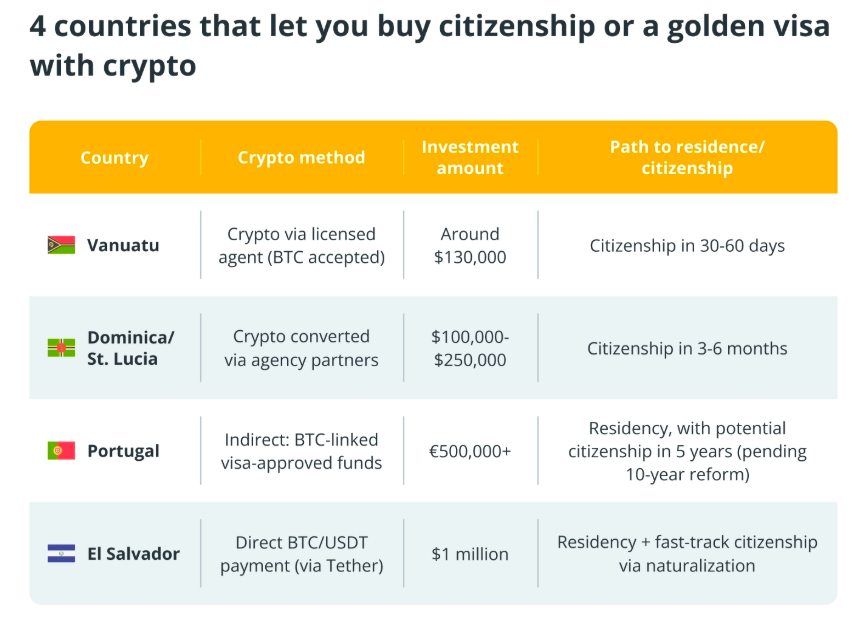
While Portugal does not accept direct crypto payments, licensed intermediaries convert digital assets into fiat. The programme grants EU residency with minimal stay requirements and a path to citizenship in five years, although legislation under review could extend this to ten. Long-term crypto gains remain tax-exempt for individuals, reinforcing Portugal’s appeal.
El Salvador: The World’s First Bitcoin Citizenship
El Salvador has positioned itself at the forefront of crypto migration through its Freedom Visa. Launched in partnership with Tether in late 2023, it offers residency and a fast-tracked route to citizenship for a $1 million investment in Bitcoin or USDT. Unlike other countries, El Salvador accepts crypto directly, bypassing fiat entirely.
The programme begins with a $999 deposit in crypto, followed by the remaining amount upon approval. The investment supports national development projects, and applicants can include their entire families. There are no physical stay requirements, and the path to citizenship can be completed within months.
Additional Developments: Kazakhstan and St. Kitts & Nevis
Kazakhstan introduced a 10-year renewable golden visa in May 2025 with a $300,000 investment in local equities or securities. While direct crypto payments are not accepted, the country is developing crypto-friendly infrastructure and regulatory sandboxes. Investors must reside for five years before applying for citizenship, with language requirements in Kazakh or Russian.
St. Kitts & Nevis does not allow crypto for direct investment but now accepts digital assets as part of an applicant’s wealth declaration under its CBI programme. Applicants must provide proof of ownership, transaction history and valuation documents. Enhanced due diligence applies in such cases.
What to Consider When Migrating With Crypto
Crypto-based migration still requires full regulatory compliance. Applicants must pass Know Your Customer (KYC) and Anti-Money Laundering (AML) checks, with assets often converted to fiat by licensed professionals. Legal support is recommended to manage documentation and navigate changing policies.
While some programmes offer direct crypto integration, others use intermediary solutions to meet government requirements. Across Vanuatu, El Salvador, Portugal and the Caribbean nations, options vary in timeline, investment size and crypto acceptance methods, providing flexibility for crypto-rich investors looking to secure a second passport or residency.
Leave a Reply