
Stablecoin Market Sees Significant Growth
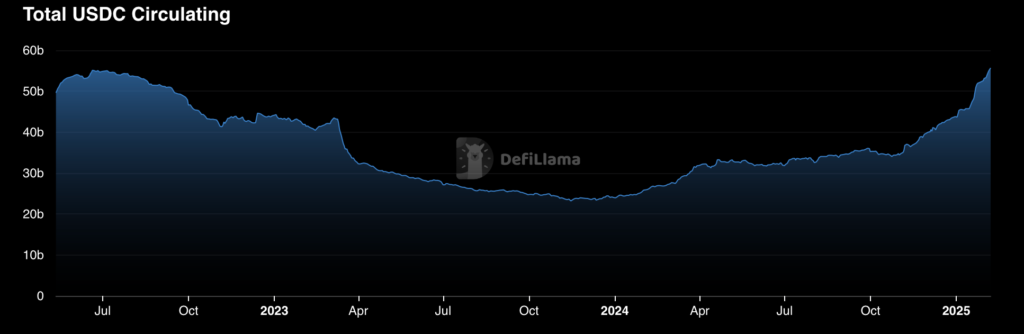
Circle’s USD Coin (USDC) has reached a market capitalisation of $56.3 billion, fully recovering from the losses incurred during the recent bear market. According to CoinGecko data, this milestone was achieved on 10 February, marking a substantial increase from its lowest valuation of $24.1 billion in November 2023.
USDC’s market cap has grown by 23.4% in just over a month, rising from $45.6 billion on 8 January. This surge follows Circle’s expansion into new blockchain ecosystems, including Sui and Aptos, alongside a significant $6 billion USDC minting on the Solana blockchain in January 2025.
Tether Maintains Lead in Stablecoin Market
Despite USDC’s rapid growth, Tether’s USDt (USDT) remains the dominant stablecoin, with a market cap of $141.6 billion as of 10 February. CoinGecko data indicates that USDT’s market cap has increased by over $4 billion in the past month.
Figures from DeFiLlama reveal that USDT continues to command 63% of the stablecoin market, while USDC’s share has risen to 25%, up from 19.4% a year ago. The overall stablecoin market has expanded significantly, growing from $121 billion in August 2023 to $224 billion in February 2025.
US Government Focuses on Stablecoin Regulation
The surge in stablecoin adoption has drawn increased attention from US policymakers. Since the start of President Donald Trump’s administration, stablecoin regulation has been a key agenda item in Washington.
David Sacks, the White House’s AI and crypto policy advisor, has highlighted the potential for stablecoins to strengthen the US dollar’s dominance globally. He stated that the administration aims to foster stablecoin innovation within the United States.
Meanwhile, Senator Bill Hagerty has introduced new legislation to establish a secure and growth-oriented regulatory framework for stablecoins. The proposed bill seeks to promote innovation while ensuring market stability.
The Role of Stablecoins in the Digital Economy
Stablecoins are digital assets pegged to traditional currencies, typically the US dollar, and play a crucial role in digital payments and financial inclusion. They are widely used in developing nations as a hedge against inflation, providing a stable store of value.
Additionally, stablecoin holders can earn yields through decentralised finance (DeFi) protocols, offering an alternative to traditional interest-bearing bank accounts. With the continued expansion of the stablecoin market, these digital assets are set to play an increasingly significant role in global finance.
Leave a Reply