
Decentralised Finance (DeFi) was launched with the bold vision of rebuilding the financial system transparent, open to all, and free from intermediaries. Over a decade later, it has delivered remarkable innovation. However, it continues to face a fundamental problem: unreliable liquidity.
At the heart of DeFi’s recurring troubles lies a dependency on “rented capital.” This short-term approach creates a fragile financial structure vulnerable to shocks. But a promising solution is emerging in the form of Chain-Owned Liquidity (CoL) and Protocol-Owned Liquidity (PoL) models that promote resilience and long-term sustainability.
The Liquidity Crisis in DeFi: A Systemic Weakness
DeFi has grown fast, but its growth is built on shaky ground. The industry often sees boom-and-bust cycles, driven by speculative trading. Liquidity pours into decentralised exchanges (DEXs) and yield farms during bull markets, only to vanish when markets cool. This pattern leaves protocols vulnerable, with high slippage, broken trading pairs, and declining user trust.
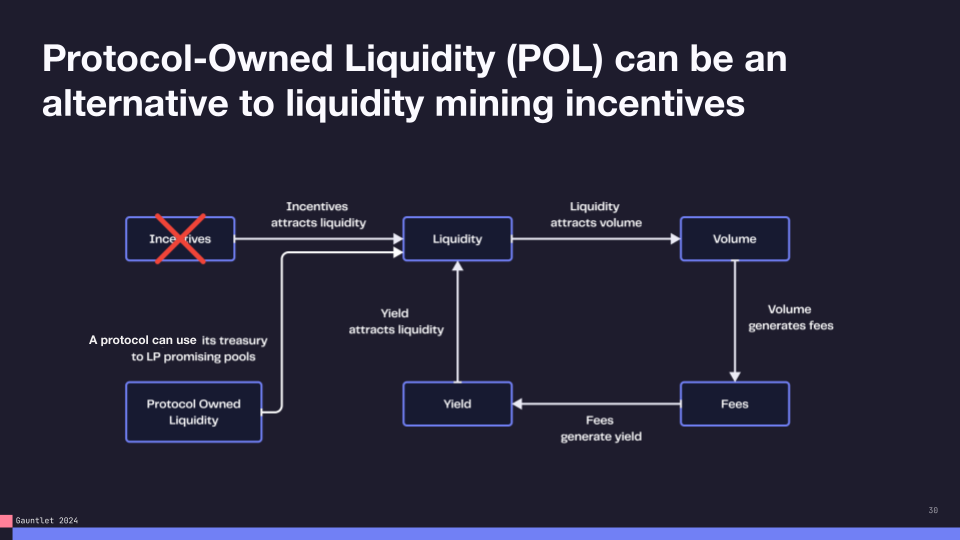
This volatility is often mistaken for a normal part of the crypto market cycle. In reality, it reflects a deeper issue: DeFi relies heavily on external liquidity providers (LPs), who are often only in it for the short-term gains. These “mercenary” LPs respond to incentives, usually high token rewards or trading fees and leave as soon as more profitable opportunities arise.
Data highlights this problem clearly:
- 42% of yield farmers exit within 24 hours of a project’s launch
- Over 70% leave by day three
This results in highly unstable markets and contributes to the failure of many DeFi protocols, regardless of how innovative or well-intentioned they are.
The Problem with Rented Liquidity
Traditional financial markets don’t suffer from liquidity collapses every few months. Imagine if the New York Stock Exchange lost half its liquidity in a single day, confidence in the system would disappear overnight. In contrast, DeFi has normalised such instability.
To bootstrap early liquidity, many DeFi platforms offer governance tokens or rewards through liquidity mining. While this may attract users quickly, it builds a user base of opportunists, not loyal participants. Once rewards run dry, these LPs withdraw, and the protocol is left exposed.
This “rented liquidity” model has led to numerous collapses. Terra’s dramatic fall is a well-known example: it was once a leading player in the space, but its overreliance on unsustainable incentives led to a complete breakdown that affected the broader crypto ecosystem.
If DeFi is to become more than a speculative playground, it must move away from these fragile models.
Chain-Owned Liquidity: A Sustainable Path Forward
Chain-Owned Liquidity (CoL) flips the liquidity model on its head. Instead of renting liquidity, a protocol or blockchain network owns and manages it.
In simple terms, this means chains use their own treasury or native tokens to provide liquidity to decentralised exchanges. This allows them to:
- Maintain stable trading environments
- Reduce reliance on external LPs
- Build long-term user trust
Protocols like Bancor and Curve have already adopted variations of this model.
- Bancor uses single-sided liquidity pools, where the protocol itself backs liquidity with its BNT tokens. This stabilises trading pairs like ETH/BNT without needing external providers.
- Curve uses its own reserves to support stablecoin pools, ensuring consistent liquidity even during market dips.
This approach is known as Protocol-Owned Liquidity (PoL), and when applied at the chain level, it becomes Chain-Owned Liquidity (CoL) extending the benefits across an entire ecosystem.
The key advantage is control. With CoL, chains aren’t held hostage by short-term market behaviour. They can weather downturns and keep services running smoothly for users.
Benefits of PoL and CoL: Resilience, Stability, and Growth
The move toward owned liquidity offers several concrete advantages:
- Resilience Against Market Volatility
Protocols are no longer at the mercy of external LPs pulling funds. They can maintain deeper and more reliable liquidity, even during bear markets or periods of uncertainty. - Stronger Ecosystem Alignment
When a chain or protocol owns its liquidity, it can align it more closely with its long-term goals. No need to spend treasury funds on short-term rewards that offer no lasting benefit. - Improved User Experience
Users benefit from lower slippage, more stable pricing, and a trading environment that doesn’t break down when rewards dry up. - Greater Investor Confidence
Institutions and long-term investors prefer systems that are stable and predictable. By using CoL, chains signal maturity and readiness for serious adoption. - Reduced Risk of Liquidity Shocks
A CoL model serves as a buffer during crashes or exploit attempts, minimising systemic risk across the DeFi space.
Challenges and the Road Ahead
Transitioning to CoL is not without its challenges. It requires:
- Smart treasury management
- Transparent governance
- A willingness to innovate beyond conventional DeFi models
There’s also the risk of over-centralisation if liquidity is only held by the protocol or chain. To avoid this, a balance must be struck between owned and user-supplied liquidity, ensuring decentralisation and trust are preserved.
Adopting CoL also calls for new developer tooling and better education for users and stakeholders. It won’t happen overnight. But the long-term benefits far outweigh the initial effort.
From Hype to Long-Term Value
The promise of DeFi was to democratise finance and serve the unbanked. But that promise cannot be fulfilled if liquidity keeps vanishing every time the market turns.
Chain-Owned Liquidity and Protocol-Owned Liquidity offer a real solution. By owning liquidity instead of renting it, DeFi protocols can build stable, self-reliant ecosystems that don’t depend on fleeting yield farming trends.
The future of decentralised finance depends on sustainable foundations. If the industry wants to mature and compete with traditional finance, it must solve the liquidity problem at its core. And CoL provides a credible, forward-looking path to get there.
By focusing on resilience over hype, DeFi can finally become more than just a crypto experiment and move closer to delivering financial access and freedom for all.
Leave a Reply