A7A5, a Russian ruble-backed stablecoin issued in Kyrgyzstan, has overtaken all its non-US dollar rivals to become the world’s largest alternative stablecoin. Despite facing heavy scrutiny and multiple sanctions, the token’s market capitalisation soared 250% in a single day, reaching nearly $500 million.
According to data from CoinMarketCap and DefiLlama, A7A5 now accounts for around 43% of the total $1.2 billion market capitalisation of all non-US dollar stablecoins. The project’s rapid ascent has reignited global debate over the role of national digital currencies and their potential to bypass Western financial controls.
Ruble-Backed Token Defies Sanctions
A7A5 was launched in February as a ruble-pegged stablecoin backed by a portfolio of fiat deposits held across Kyrgyzstan’s banking network. It promised holders a daily passive income equal to half the interest earned on these deposits. Initially issued on Ethereum and Tron, the token quickly drew the attention of blockchain analysts.
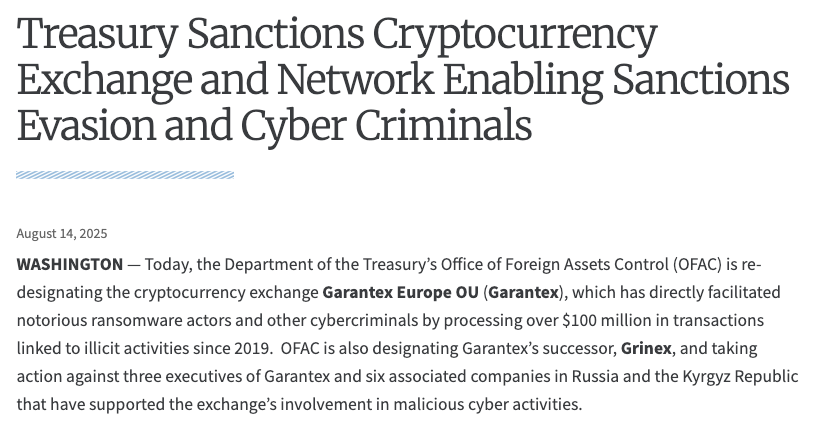
Investigators soon connected A7A5 to Grinex, a crypto exchange viewed as the successor to Garantex, a Russian exchange previously sanctioned by the United States. By mid-August, the US Treasury had extended sanctions to include Garantex and related entities, identifying Moldovan oligarch Ilan Shor as the owner of A7A5’s issuer, the sanctioned Russian bank Promsvyazbank (PSB).
The United Kingdom also imposed restrictions on several Kyrgyz banks after reports suggested that Russia was using A7A5 to skirt Western financial barriers.
Sudden Market Surge Raises Eyebrows
For months, A7A5’s market value fluctuated between $120 million and $140 million. However, on September 25 its market capitalisation spiked by $350 million in a single day — a 250% jump — propelling it to the top of the non-US dollar stablecoin market.
The surge placed A7A5 ahead of Circle’s euro-denominated EURC, which stood at $252 million at the time of writing. The timing of the increase, just days before the Token2049 conference in Singapore, raised further questions within the crypto community.
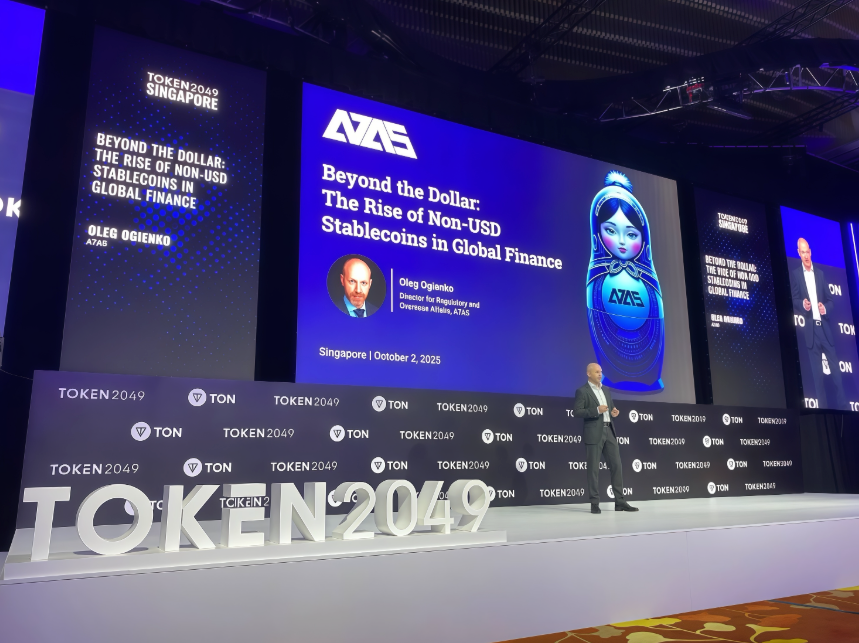
At the event, A7A5 executives hosted a booth, and representative Oleg Ogienko took the stage. Their participation quickly sparked controversy, with several attendees calling for stricter compliance checks and for closing regulatory loopholes at global industry gatherings.
A7A5 Responds with Defiance
In a Telegram post published that weekend, A7A5 claimed its success demonstrated the growing strength of national digital currencies. “We have already proven that a national digital currency can be not only an alternative to the dollar but also a driver of global change,” the message read.
The declaration was seen as a direct challenge to Western regulators, who have increasingly focused on digital asset networks linked to sanctioned entities. Despite ongoing scrutiny, the project’s market presence has continued to grow across multiple regions.
Growing Ties with China and Africa
According to the Centre for Information Resilience (CIR), trade with China has emerged as A7A5’s main area of activity. The non-profit organisation reported that 78% of the token’s transactions passed through Chinese jurisdictions as of August 2025.
CIR also noted that A7A5 has been expanding rapidly across Africa, establishing offices in Nigeria and Zimbabwe to facilitate cross-border digital payments. The organisation warned that these developments may warrant deeper investigation into the stablecoin’s operational network and possible geopolitical implications.
“Further research will be needed to comprehensively understand how funding flows through the organisation’s network, the potential role of financial institutions in enabling its operations and any linkages to Russian political interference schemes,” CIR stated in its report.
Regulatory Questions Remain Unanswered
The rapid rise of A7A5 highlights the challenges regulators face as state-linked and sanctioned entities increasingly turn to blockchain technology. Although its backers promote it as a legitimate alternative to Western-dominated finance, critics argue that such stablecoins could undermine international efforts to enforce sanctions.
As of now, neither A7A5 nor its representatives have responded to requests for comment regarding the token’s extraordinary growth and ongoing controversies.
Despite the uncertainty, A7A5’s trajectory underscores a broader trend: the rise of non-US dollar stablecoins driven by nations seeking to lessen their reliance on Western financial systems. Whether this surge represents innovation or evasion remains a question global regulators are yet to answer.
Leave a Reply