The global cryptocurrency market was thrown into turmoil late Friday after President Donald Trump announced sweeping 100% tariffs on Chinese imports, igniting panic across traditional and digital markets alike. Within hours, nearly $200 billion was wiped from global crypto capitalization, sending major coins into a freefall.
Yet as traders rushed to cut losses or hedge positions, the world’s largest crypto exchange, Binance, became the epicentre of a growing storm. Users across the globe reported frozen accounts, failed stop-loss orders, and flash crashes that sent several tokens to near-zero values before abruptly rebounding.
The incident has since spiralled into one of the most severe public relations crises for Binance, with traders accusing the exchange of systemic manipulation, negligence, and opaque internal practices.
Altcoins Crash to Zero Amid Trading Freeze
Social media platforms erupted with fury as screenshots and trading records emerged showing abrupt price collapses. Coins such as Enjin (ENJ) and Cosmos (ATOM) briefly traded at $0.0000 and $0.001, respectively, before stabilising moments later.
During the chaos, many users reported being locked out of trading functions, claiming that both limit and stop-loss orders failed to execute while order books appeared frozen. For some, losses mounted within minutes as leveraged positions were automatically liquidated.
“I watched my portfolio vanish in real-time and couldn’t do anything,” one trader posted on X (formerly Twitter). “Binance just froze, stop losses didn’t trigger, and by the time it recovered, everything was gone.”
While Binance acknowledged “temporary system delays and display issues” caused by what it called “unprecedented market activity,” it insisted that all user funds remain SAFU, a reference to its Secure Asset Fund for Users.
However, for traders who saw their portfolios wiped out in seconds, reassurance offered little comfort. Many accused the exchange of profiting off forced liquidations while users were locked out.
Accusations of Manipulation Intensify
The outrage intensified as several high-profile traders alleged that Binance intentionally suspended critical order functions during the heaviest volatility to capitalise on cascading liquidations. Some claimed that both long and short positions were simultaneously liquidated while liquidity data vanished from the screen.
Others pointed out that this is not the first time Binance has faced such allegations. Earlier this year, a similar incident occurred during a smaller market correction, when sudden service halts coincided with major price swings.
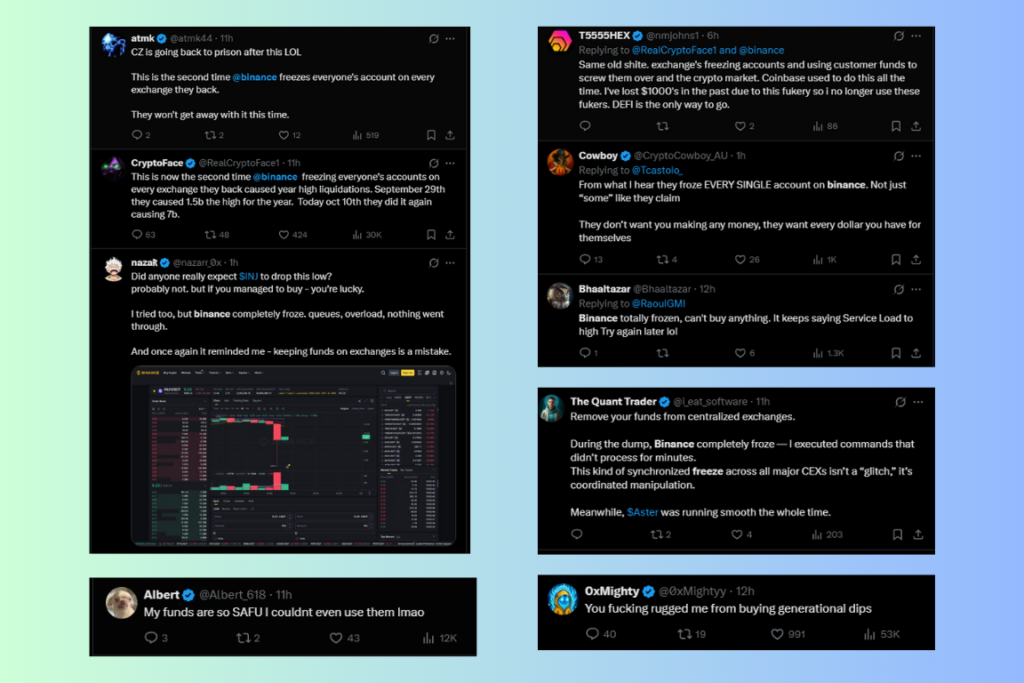
Critics argue that Binance’s repeated technical issues during volatile conditions reveal deeper systemic flaws or potential market abuse. “It’s becoming a pattern, every time the market moves sharply, Binance’s system just happens to ‘glitch’ in their favour,” one analyst commented.
Calls are now mounting for regulatory scrutiny into Binance’s internal controls and trading engine operations. Traders are urging authorities to demand transparency over how the exchange handles liquidation mechanisms, latency management, and system testing during high-volume events.
Other Exchanges Also Buckle Under Pressure
Binance wasn’t alone in facing technical turmoil. Coinbase and Robinhood also confirmed experiencing partial outages and trading disruptions during the same time frame.
However, Binance drew disproportionate backlash due to its dominant market share and history of prior incidents. With billions in daily trading volume, even a brief outage can have enormous financial repercussions.
Some market analysts suggested that the simultaneous failures across multiple exchanges highlighted infrastructure weaknesses across the crypto industry, particularly the reliance on centralised trading platforms to process immense bursts of volatility.
Retail traders have since revived the long-standing rallying cry: “Not your keys, not your coins.” Social channels are again filled with calls for investors to withdraw funds to self-custody wallets and shift to decentralised exchanges (DEXs) where control remains in users’ hands.
Binance Promises Stability, But Confidence Shaken
In its latest update, Binance stated that all systems are “fully operational”, though some users continue to report delayed withdrawals and frozen P2P transactions. The company has not announced any compensation plan for affected users, merely reiterating that investigations are underway.
While markets have since stabilised slightly, confidence in Binance’s reliability, once seen as rock-solid, has been severely dented. For many traders, this incident marks a turning point in how they view centralised exchanges amid extreme volatility.
As global regulators and watchdogs take note, Binance faces perhaps its toughest test yet, restoring trust in an ecosystem where transparency and accountability remain under constant scrutiny.
Leave a Reply