Crypto mining firm TeraWulf is preparing to raise $500 million through a private convertible note offering, betting that its expertise in high-powered infrastructure can position it as a key player in the fast-growing AI computing market. The company aims to use the funds to build a new data center campus in Abernathy, Texas, and support other corporate initiatives.
$500 Million Convertible Offering for Texas Expansion
The financing will be offered to qualified institutional buyers, according to the company’s Wednesday announcement. Underwriters will also have the option to purchase an additional $75 million in notes within 13 days of issuance, depending on market conditions.
The convertible senior notes, due May 1, 2032, will not carry regular interest. Conversion will only be allowed under specific conditions before February 2032, giving investors flexibility to exchange the notes into cash, TeraWulf shares, or a mix of both. Final pricing and conversion details will be determined closer to the issue date.
Proceeds from the offering will primarily fund construction of the Texas data center, a large-scale facility expected to support power-intensive computing workloads, as well as general corporate purposes.
Building on a Multi-Billion-Dollar Financing Push
The latest fundraising follows TeraWulf’s ambitious expansion strategy centered on AI-driven infrastructure. Earlier this year, reports surfaced that the company was working with Morgan Stanley to secure up to $3 billion in debt financing. The move was bolstered by Google’s $1.4 billion backstop, designed to ensure financial stability for the miner’s next-generation data centers.
In August, TeraWulf signed a $3.7 billion hosting agreement with AI infrastructure firm Fluidstack, which is backed by Google. The deal not only deepens TeraWulf’s presence in AI computing but also brought Google in as a 14% shareholder in the company.
These partnerships mark a clear strategic shift from traditional crypto mining toward AI and high-performance computing (HPC). By leveraging its established energy contracts and mining facilities, TeraWulf is positioning itself to meet the surging demand for data center capacity and reliable power sources—two of the most pressing challenges in the AI industry today.
Riding the Wave of Data Center Shortages
The surge in AI-related computing needs has sparked a scramble for data center real estate, advanced GPUs, and electricity infrastructure. Tech giants and financial institutions are pouring billions into facilities that can handle large-scale training and inference workloads.
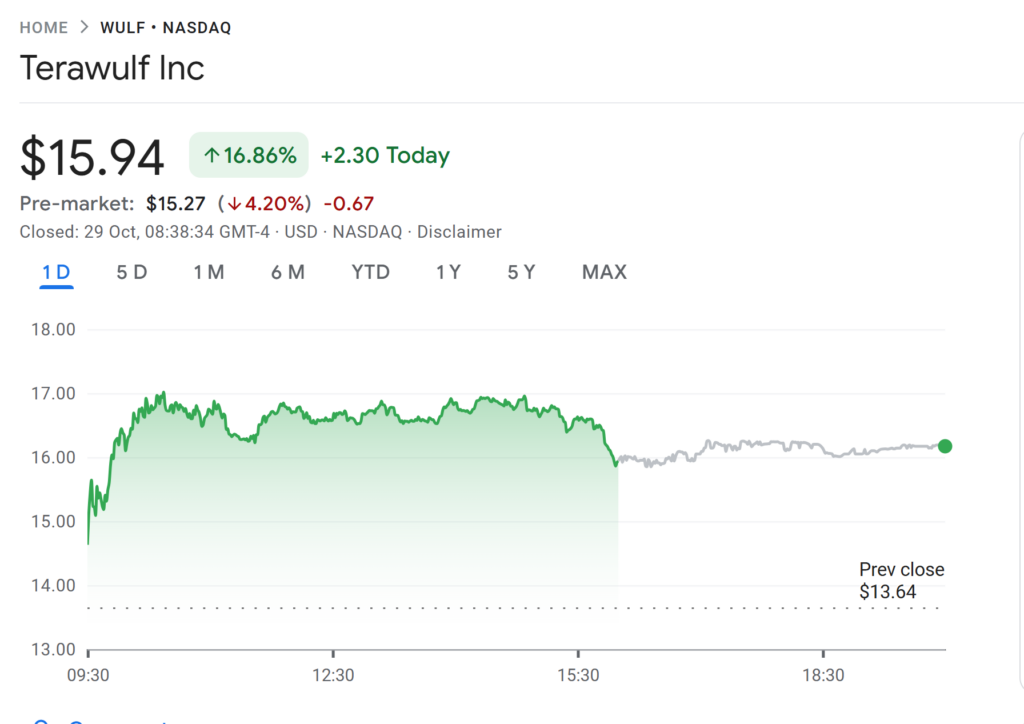
Crypto miners like TeraWulf, which already operate massive facilities with access to cheap, consistent energy, are emerging as natural beneficiaries of this trend. Their ability to repurpose or expand existing sites gives them a crucial edge in speed and cost compared to new entrants building from scratch.
With Texas rapidly becoming a hub for energy-intensive computing projects, TeraWulf’s new Abernathy campus could play a significant role in meeting regional AI demand.
Galaxy Digital Joins the Texas Data Center Race
TeraWulf isn’t the only crypto-linked company pivoting toward AI infrastructure. Galaxy Digital, led by Mike Novogratz, recently secured $460 million from one of the world’s largest asset managers to accelerate its Helios AI data center expansion in Texas.
The deal involved the purchase of 12.77 million Class A shares at $36 each, and aims to deliver 133 megawatts of IT capacity by early 2026. It builds on Galaxy’s $1.4 billion loan from August, which covered 80% of the Helios project’s construction costs.
Under a 15-year agreement with CoreWeave, Galaxy will provide computing resources for AI and high-performance workloads—a deal projected to generate roughly $1 billion in annual revenue once operational.
A New Era for Crypto Infrastructure Firms
As traditional crypto mining becomes less profitable and regulatory scrutiny increases, many miners are rebranding as AI infrastructure providers. The move allows them to leverage existing assets—power contracts, cooling systems, and real estate—to capture opportunities in a more sustainable, higher-margin industry.
For TeraWulf, this latest $500 million offering signals confidence in the company’s long-term shift toward AI-ready operations. With strong backing from major financial and tech players, its strategy could reshape how former mining companies compete in the next phase of digital infrastructure growth.
While market conditions remain uncertain, TeraWulf’s bet on AI as “the new Bitcoin” reflects a broader belief spreading through the sector: that the next wave of digital wealth will be mined not through crypto algorithms, but through compute power fueling artificial intelligence.
Leave a Reply