The US Treasury is facing growing tensions between crypto firms and traditional banks as it works to implement the GENIUS Act, a new law shaping how stablecoin payments are regulated across the country. At the center of the dispute is whether companies like Coinbase should be allowed to offer interest on stablecoin holdings — a question that could define the future of digital dollar-like assets in the United States.
Coinbase Pushes for Limited Restrictions
Coinbase, one of the largest US-based crypto exchanges, has urged the Treasury Department to interpret the GENIUS Act narrowly, restricting the ban on stablecoin interest payments only to stablecoin issuers — the entities that create and manage these tokens. In a letter submitted this week, the company argued that non-issuers, including exchanges, wallets and other service providers, should retain the right to offer yield on stablecoin deposits.
According to Coinbase, this approach stays true to Congress’s intent when it passed the GENIUS Act earlier this year. “Congress went no further,” the exchange wrote, claiming that lawmakers deliberately chose not to prohibit third parties from offering stablecoin yields because doing so would have “inhibited growth and innovation” in the emerging digital asset market. Coinbase added that the Treasury “has no authority to second-guess Congress’s work.”
Banking Groups Demand Blanket Ban
Traditional banks see the issue very differently. The Bank Policy Institute (BPI), joined by several major banking trade groups, has called on the Treasury to go beyond the narrow interpretation proposed by Coinbase. They want a sweeping prohibition on any form of interest or yield linked to stablecoins — even if the payment comes through intermediaries or affiliates.
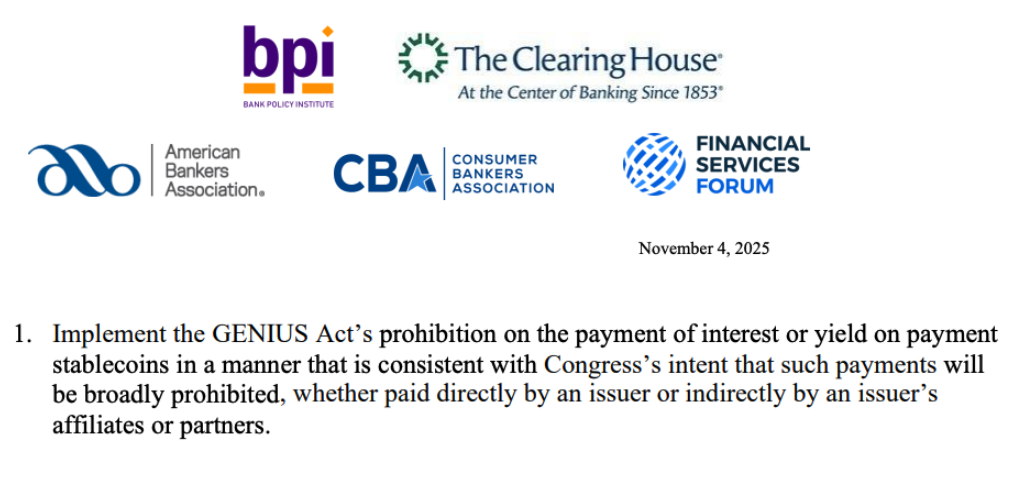
In a statement released on Tuesday, BPI urged the Treasury to “implement the GENIUS Act’s prohibition on the payment of interest or yield on payment stablecoins, whether paid directly by an issuer or indirectly through affiliates or partners.” The group argues that allowing stablecoin yield products could draw massive amounts of money away from the banking system, potentially destabilizing traditional deposits.
This is not the first time banks have raised the alarm. In August, BPI and its allies warned that the rise of interest-bearing stablecoins could trigger as much as 6.6 trillion dollars in outflows from bank deposits — a shift that could reshape how Americans save, lend and move money.
Industry Divided as Treasury Reviews Feedback
The latest round of comments was submitted as part of the Treasury’s advance notice of proposed rulemaking, a formal process where industry players provide input before final regulations are drafted. This marks the second public comment period for the GENIUS Act’s implementation, which concluded earlier this week.
The clash highlights the deep divide between traditional finance and the crypto industry over how stablecoins should fit into the broader financial system. For banks, stablecoins offering yield represent a direct threat to deposits — the lifeblood of their lending operations. For crypto companies, yield products are a natural evolution of digital money that can make blockchain-based payments more attractive and efficient.
Coinbase Defends Innovation and Clarity
In addition to its stance on yield, Coinbase’s letter also urged the Treasury to exclude non-financial software developers, blockchain validators and open-source protocol contributors from the scope of the GENIUS Act. The exchange argued that these groups play a purely technical role in the ecosystem and should not be burdened with regulatory requirements intended for financial entities.
Coinbase further recommended that stablecoins be treated as “cash equivalents” for accounting and tax purposes — a move that would make it easier for businesses and investors to handle them within existing financial frameworks. Such recognition could also boost adoption by companies hesitant to navigate unclear tax rules around digital assets.
Implementation Timeline Still Unclear
The GENIUS Act, signed into law in July, aims to establish a unified national framework for stablecoin payments, bringing clarity to an area long marked by uncertainty and fragmented state-level rules. The law will take effect either 18 months after its enactment or 120 days after federal regulators issue the final rules, whichever comes later. Based on current timelines, that means the new regulations could begin applying by late 2026 or early 2027.
Until then, the Treasury’s rulemaking process will continue to serve as a battleground for competing visions of how stablecoins should function in the economy. Banks want to ensure that digital assets do not undermine traditional finance, while crypto firms are pushing for flexibility to experiment with yield-bearing products.
The outcome will determine not only who gets to pay interest on stablecoins but also how far the US government is willing to go in shaping the next chapter of digital finance.
Leave a Reply