
Decentralized finance teams are quietly rethinking one of crypto’s most popular community tools. Once seen as the heart of user engagement, public Discord servers are increasingly being viewed as risky spaces where scammers thrive and genuine support becomes harder to deliver. Several major DeFi projects are now shifting away from always open chat rooms toward ticket based help desks and controlled support systems.
From community hub to security headache
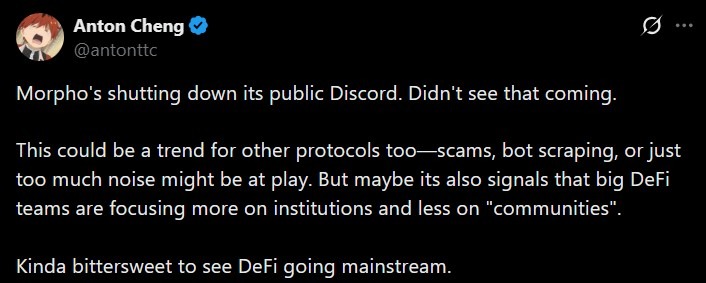
The conversation gained traction this week after DeFi lending protocol Morpho announced that its public Discord server had been placed in read only mode. Users are now being redirected to alternative support channels designed to reduce the risk of fraud. According to the team, the decision followed repeated incidents where users seeking help were targeted by impersonators and phishing attempts.
Morpho co founder Merlin Egalite said the move was difficult, given how central Discord has been to crypto communities for years. Still, he noted that even with constant monitoring and safeguards, scammers were able to exploit the platform’s structure. Direct messages, in particular, have become a major attack vector that projects struggle to control.
Morpho has been testing customer support tools like Intercom, which allow users to submit tickets and receive structured responses. Egalite said these systems make it easier to manage support while limiting exposure to bad actors.
Builders move toward structured support
Morpho is not alone. DefiLlama founder 0xngmi said the data platform has been gradually reducing its reliance on Discord in favor of live chat and email based support. In his view, Discord makes it nearly impossible to protect users at scale.
Even when scammers are banned quickly, they often continue to target users through private messages, posing as team members or moderators. For platforms with large user bases, the problem becomes less about moderation effort and more about structural limitations.
Several builders argue that the industry has leaned too heavily on always on chat rooms in the name of openness. They say the focus is now shifting toward support systems that prioritize user safety and clear communication over constant engagement.
Industry voices back the Discord exit
The move away from Discord has drawn support from across the crypto industry. Richard Rodairos, a talent partner at venture firm Dragonfly, described public Discord servers as one of the lowest signal environments in crypto today. He argued that projects would be better served by strong documentation, asynchronous communication and reliable support channels.
Rodairos suggested that removing most Discord servers could benefit the industry in the long run by reducing noise and risk. Similar sentiments were echoed by Marc Zeller, founder of the Aavechan Initiative, who said Discord has become overrun with scammers posing as administrators. Zeller praised Morpho’s decision and encouraged Aave Labs to consider a similar step.
Duncan Cock Foster, co founder of NFT marketplace Nifty Gateway, also weighed in. He said that moderating Discord was the most draining part of running his company and took a toll on his mental health. In his view, stepping back from the platform is a practical and healthy move for teams.
Concerns about losing open collaboration
Despite growing criticism, not everyone agrees that abandoning Discord is the right answer. Some community members worry that leaving the platform could undermine one of DeFi’s defining traits: open, peer driven collaboration.
An X user known as Llamaonthebrink said the ability to join a project’s Discord, ask questions and follow development discussions is a key reason many people are drawn to DeFi. They warned that a broad retreat from Discord could make projects feel more closed off and less accessible to newcomers.
Others argue that the problem lies more with how Discord is managed rather than the platform itself. Another X user, nft_dreww, said scammers exist on every platform and that well run Discord servers with strong security practices can still offer value. A similar view came from Walter_Su11ivan, who suggested that many projects continue to operate healthy and well moderated communities on Discord.
A shift in how DeFi communicates
The debate highlights a broader shift in how DeFi teams think about communication. As the sector matures and user numbers grow, informal chat rooms are proving harder to secure. For some projects, the cost of maintaining open Discord servers now outweighs the benefits.
Rather than a sudden exodus, the trend appears to be a gradual repositioning. Many teams are not eliminating Discord entirely but limiting its role, using it for announcements or read only updates while moving support and sensitive interactions elsewhere.
Whether Discord remains a core pillar of DeFi communities or fades into a secondary role will likely depend on how platforms balance openness with safety. For now, the quiet breakup reflects a growing recognition that protecting users may require rethinking long held assumptions about community building in crypto.
Leave a Reply