
Decentralized social networking protocol Farcaster will return 180 million dollars to investors following its acquisition by infrastructure provider Neynar, even as the platform continues normal operations. The move marks a rare moment in crypto where a venture-backed startup opts to give back its entire raised capital while transitioning stewardship of its core protocol.
Farcaster co-founder Dan Romero addressed community concerns after the acquisition announcement, making it clear that the protocol is not shutting down and remains active, with plans to evolve under new leadership.
Farcaster Remains Live and Active
Romero pushed back against speculation that the project was winding down, emphasizing that Farcaster continues to see steady usage. According to him, the protocol recorded around 250,000 monthly active users in December and has more than 100,000 funded wallets.
Farcaster operates as a decentralized social protocol, allowing developers to build interoperable applications where users own their identities, social graphs, and connections onchain. Unlike traditional social platforms, users are not locked into a single app or company, making portability a core feature of the ecosystem.
Romero said these fundamentals remain intact and that the protocol will continue operating without disruption following the leadership transition.
Neynar Takes Over Stewardship
As part of the acquisition, Neynar will assume responsibility for maintaining Farcaster’s protocol contracts, code repositories, and consumer-facing app. Neynar is a venture-backed startup that has been deeply embedded in the Farcaster ecosystem from its earliest days, operating one of the first Farcaster clients and providing infrastructure used by a large portion of developers building on the protocol.
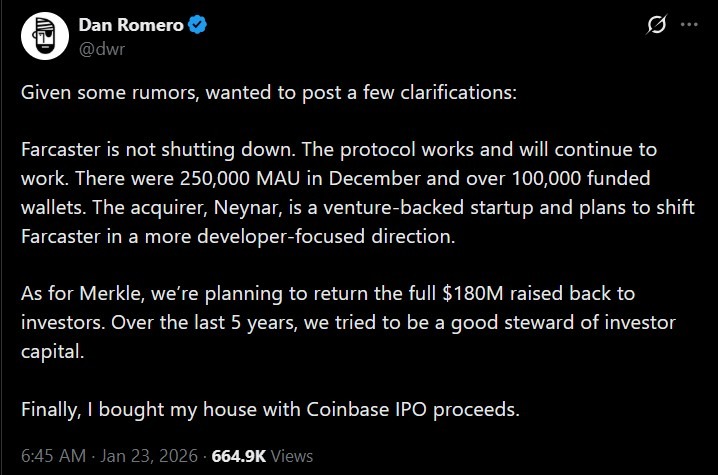
Romero noted that Neynar plans to guide Farcaster in a more developer-focused direction, aligning with its existing role as a core infrastructure provider. The acquisition formalizes a relationship that has existed for years, rather than introducing an entirely new operator.
Following the handover, Romero and several members of the Farcaster team will step away from day-to-day operations and move on to new projects, marking the end of Merkle Manufactory’s active role in running the protocol.
Why Farcaster Is Returning Investor Capital
Merkle Manufactory, the company behind Farcaster’s development, raised significant venture funding over the past few years. In July 2022, it raised 30 million dollars from a16z crypto. A subsequent funding round in March 2024, led by Paradigm, reportedly valued the company at over 1 billion dollars.
Romero said that the total capital raised by Merkle Manufactory across its lifetime amounted to 180 million dollars. In a public post, he confirmed that the company plans to return the full amount to investors.
He described the decision as the result of five years of development and an effort to act as responsible stewards of investor capital. According to Romero, returning the funds reflects a belief that the company has reached a natural transition point rather than a failure of the protocol itself.
Merkle Manufactory did not respond to requests for additional comment before publication.
Investor Reaction and Community Response
The announcement drew reactions from several high-profile investors. Balaji Srinivasan, an early Farcaster investor, confirmed that investor funds were being returned and praised the team’s work on decentralized social infrastructure.
Within the community, reactions were mixed but largely respectful, with many viewing the move as unconventional but principled in an industry where capital is rarely returned voluntarily.
The return of funds, combined with the transfer of stewardship to Neynar, positions Farcaster as a protocol stepping away from a traditional startup path while continuing as an open social network.
Decentralized Social Sees Broader Leadership Shifts
Farcaster is not alone in undergoing structural changes. This week, Lens Protocol, another decentralized social project, also announced a leadership transition. The Aave team said it has handed over stewardship of Lens to Mask Network, allowing Aave to refocus on decentralized finance while staying involved in Lens as a technical advisor.
These changes come amid renewed discussion around the future of online communication. Ethereum co-founder Vitalik Buterin recently voiced strong support for decentralized social platforms, urging builders and users to spend more time in open social ecosystems.
Buterin argued that the industry must move beyond centralized information environments and explore new forms of online interaction. He said that better mass communication tools are essential for building a healthier society.
As projects like Farcaster and Lens evolve beyond their original teams, decentralized social media appears to be entering a new phase, one defined less by startup growth narratives and more by long-term protocol stewardship.
Leave a Reply