
Bitcoin tumbled over the weekend after the United States and Israel announced a coordinated military operation targeting Iran’s nuclear infrastructure. With traditional financial markets closed, crypto traders were left to react first to the geopolitical shock, pushing BTC down nearly 4 percent to test the $63,000 level.
The sudden escalation added fresh pressure to an already fragile market, as Bitcoin heads toward what could be its fifth straight month of losses.
Crypto Reacts While Traditional Markets Stay Shut
According to TradingView data, Bitcoin fell sharply on Saturday, briefly hovering around $63,000 as investors digested news of the strikes. With US stock exchanges closed for the weekend and futures yet to reopen, crypto markets became the only active arena reflecting investor sentiment.
Liquidations accelerated as volatility picked up. Data from CoinGlass showed more than $250 million in positions wiped out within four hours. The rapid sell-off highlighted how sensitive digital assets remain to geopolitical developments, especially when liquidity is thinner over the weekend.
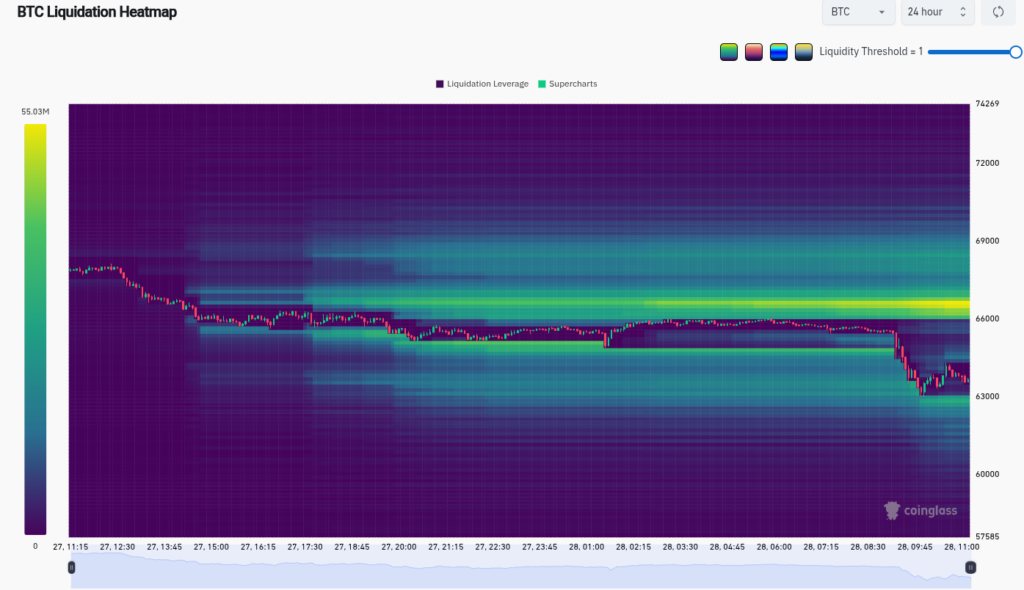
Unlike equities and commodities, which will only reflect the full impact once futures trading resumes, crypto provided an immediate gauge of risk appetite.
Trump Confirms Operation, Calls for Political Change in Iran
In a video address, US President Donald Trump confirmed that the joint operation focused on Iran’s nuclear facilities. He described the strikes as a decisive action against strategic infrastructure.
Trump also delivered a pointed message to the Iranian public, urging them to take control of their government once military operations conclude. “When we are finished, take over your government; it will be yours to take,” he said, adding that it may be a rare opportunity for change.
The remarks underscored the seriousness of the confrontation and intensified concerns about further regional instability. Analysts warned that prolonged conflict could weigh heavily on global markets, particularly risk assets such as cryptocurrencies.
Echoes of Previous Iran Tensions
Market commentators quickly drew comparisons to an earlier flare-up involving Iran in 2025, which triggered sharp swings across both crypto and traditional markets. The Kobeissi Letter noted on X that this marks the second major confrontation involving Iran in less than a year.
That earlier episode saw Bitcoin and other digital assets experience heightened volatility as investors sought to reposition amid uncertainty. The latest developments appear to be following a similar pattern, though it remains unclear whether the reaction will deepen once broader financial markets reopen.
Historically, geopolitical shocks have produced mixed outcomes for Bitcoin. While some investors view it as a hedge during instability, initial reactions often resemble traditional risk-off moves, with prices sliding alongside equities.
Technical Pressure Builds Ahead of Monthly Close
The timing of the escalation adds another layer of complexity for traders. Bitcoin is approaching the end of February trading with losses already mounting. If current levels hold, it could mark the fifth consecutive negative month for BTC, a streak not seen in seven years.
Earlier in the week, Bitcoin bulls attempted to reclaim the $70,000 region but failed to sustain momentum. Adding to the headwinds, hotter-than-expected US inflation data released Friday dampened expectations for near-term interest rate cuts, further pressuring speculative assets.
Despite the latest drop, key support levels have not yet broken decisively. Traders are watching the $63,000 zone closely, as a sustained move below it could open the door to deeper downside. Conversely, stabilization around current levels may signal that the market is absorbing the geopolitical shock without broader panic.
For now, crypto remains the first barometer of investor nerves. The real test may come when US futures and global equity markets reopen, revealing whether Bitcoin’s weekend slide was an early warning or a contained reaction.
Leave a Reply