
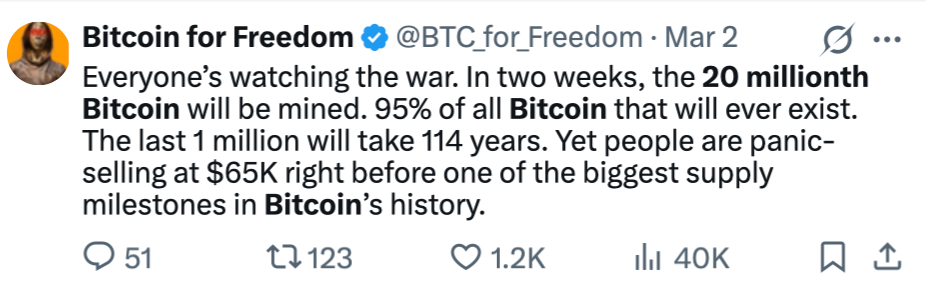
The Bitcoin network has crossed a major milestone with the mining of its 20 millionth coin, bringing the world’s largest cryptocurrency closer to its maximum supply limit. With only one million Bitcoin left to be mined over the next century, the event has reignited discussions about scarcity, long term value, and the future of the network.
Bitcoin was designed with a fixed supply of 21 million coins. This built in limit has long been one of its defining features, setting it apart from traditional fiat currencies that can be printed by governments and central banks.
A Milestone in Bitcoin’s Supply Timeline
The creation of the 20 millionth Bitcoin means nearly 95 percent of the total supply has already been mined. The remaining one million coins will be released slowly over time, with the last Bitcoin expected to be mined around the year 2140.
At present, around 450 new Bitcoins are produced each day through the mining process. This rate is not constant. It falls roughly every four years due to an event known as the Bitcoin halving, which cuts the reward miners receive for validating transactions.
Because of this mechanism, the supply of new Bitcoin entering the market becomes smaller over time. Supporters of the cryptocurrency believe this gradual reduction strengthens its position as a scarce digital asset.
Energy Co managing partner David Eng highlighted the significance of the milestone in a recent post on X, noting that markets may soon experience a global asset with almost no new supply left.
Predictable Supply Seen as Bitcoin’s Key Strength
Industry leaders say the clear and fixed issuance schedule is one of Bitcoin’s most powerful characteristics.
Raphael Zagury, CEO of Bitcoin mining company Elektron Energy, said the level of transparency surrounding Bitcoin’s supply is unlike anything seen in traditional financial systems.
According to him, the schedule for new coin issuance is known decades in advance. This clarity allows investors and participants in the network to understand exactly how the supply will evolve over time.
Humans tend to value predictable systems, particularly when it comes to money, Zagury said, adding that the countdown to the final one million coins reinforces what makes Bitcoin unique.
Tommy Rogulj, portfolio manager at crypto exchange Swyftx, echoed a similar view. He said Bitcoin’s supply structure makes it a hard capped asset that operates independently of government control.
In his view, this matters more in a world facing economic uncertainty, geopolitical tensions, and rapid technological shifts.
Scarcity Narrative Gains Strength
The milestone has also renewed attention on the scarcity narrative surrounding Bitcoin. With a fixed supply and a decreasing rate of new coins entering circulation, many supporters believe the cryptocurrency could become increasingly valuable over time.
Asset management firm Grayscale Investments previously pointed out that a digital money system with a predictable and limited supply is gaining interest among investors.
The firm argued that such a system offers an alternative to fiat currencies, especially at a time when concerns about inflation, currency debasement, and broader financial risks remain part of global economic discussions.
For many Bitcoin advocates, the shrinking number of coins left to mine serves as a reminder that the asset cannot be expanded like traditional money.
Analysts Say the Milestone May Not Move Prices
Despite the symbolic importance of the event, several analysts believe it is unlikely to influence Bitcoin’s price in the short term.
Charles Edwards, founder of Capriole Investments, said the market has long been aware of Bitcoin’s supply dynamics. Because the issuance schedule is fully transparent, investors have already factored it into their expectations.
According to Edwards, the growth rate of Bitcoin’s supply is already lower than that of gold, and the 20 million mark does not introduce any new information to the market.
Zagury also noted that broader factors such as global liquidity conditions and macroeconomic trends continue to have a stronger influence on Bitcoin’s price movements.
While the milestone may not trigger immediate price changes, he believes the long term combination of scarcity and predictable policy remains an important part of Bitcoin’s appeal.
At the time of publication, Bitcoin was trading at around 68,670 dollars, according to data from CoinMarketCap. The cryptocurrency is currently down about 19 percent over the past year.
What Happens After the Final Bitcoin Is Mined
The approach toward the final one million coins has also revived an ongoing debate within the crypto community about the network’s long term security.
Currently, miners are rewarded with newly minted Bitcoin along with transaction fees for validating transactions and securing the blockchain. Once the final coin is mined, new issuance will end.
At that stage, the network will rely entirely on transaction fees to compensate miners. Supporters argue that a mature Bitcoin economy with widespread usage could generate enough fees to maintain strong network security.
However, some observers have raised concerns that this shift could lead to higher transaction costs for users if miners depend solely on fees for revenue.
Even so, the final milestone remains more than a century away. For now, the mining of the 20 millionth Bitcoin stands as a symbolic step in the cryptocurrency’s journey toward its fixed supply limit.
Leave a Reply