
The Bank of England (BoE) is standing at a pivotal moment in the global shift toward digital finance, a transition defined by competing visions of how money itself should evolve.
On one side are advocates for central bank digital currencies (CBDCs), who argue that a digital pound is vital to safeguard monetary sovereignty and maintain public trust in money. On the other, proponents of stablecoins, privately issued, blockchain-based digital currencies, insist the private sector is better equipped to innovate and modernise payment systems.
Caught between these camps, the BoE is navigating a complex policy landscape that blends technological promise with regulatory caution. As the debate intensifies, the UK’s path forward could redefine not just its own financial system but also its role in the global digital economy.
Stablecoins vs. the Digital Pound: An Evolving Debate
The BoE’s engagement with digital currency predates the crypto boom. As early as 2014, the central bank published research exploring the implications of privately issued digital currencies, a month before Tether’s USDT, the world’s first stablecoin, was launched.
That early analysis warned of the risks of “free banking” scenarios, where private issuers might expand the money supply beyond reserves, leading to inflationary instability. It foreshadowed today’s debates about whether unregulated stablecoins could erode central banks’ control over monetary policy.

By 2016, then–Deputy Governor Ben Broadbent became one of the first global policymakers to outline the potential role of a CBDC, viewing it primarily as a technological upgrade to enhance payment efficiency and access to central bank money.
Fast forward to 2020, and the BoE’s seminal discussion paper reframed CBDCs as a counterbalance to stablecoins, reflecting their growing influence. Since then, the “digital pound” sometimes dubbed “Britcoin” has evolved from a theoretical concept into a serious policy consideration.
Yet, not everyone is convinced. A 2022 House of Lords report argued that a retail CBDC could “create more challenges than it solves,” warning of potential disruption to commercial banks. Lawmakers acknowledged that a wholesale CBDC for institutional settlements might hold more promise, but urged caution in pursuing a retail version.
Despite such reservations, the BoE continues to advance research and stakeholder discussions on digital money, aware that inaction could see the UK fall behind global peers.
Stablecoin Regulation and Public Trust
Minutes from the BoE’s CBDC Advisory Group meeting in June 2025, released on 7 October, reveal growing concern that delays in rolling out a digital pound could entrench private stablecoins and erode public control over the monetary system.
Participants reportedly urged that a digital pound be seen not as a mere technical upgrade but as a strategic tool for monetary sovereignty in a world where private tokens could dominate payments.
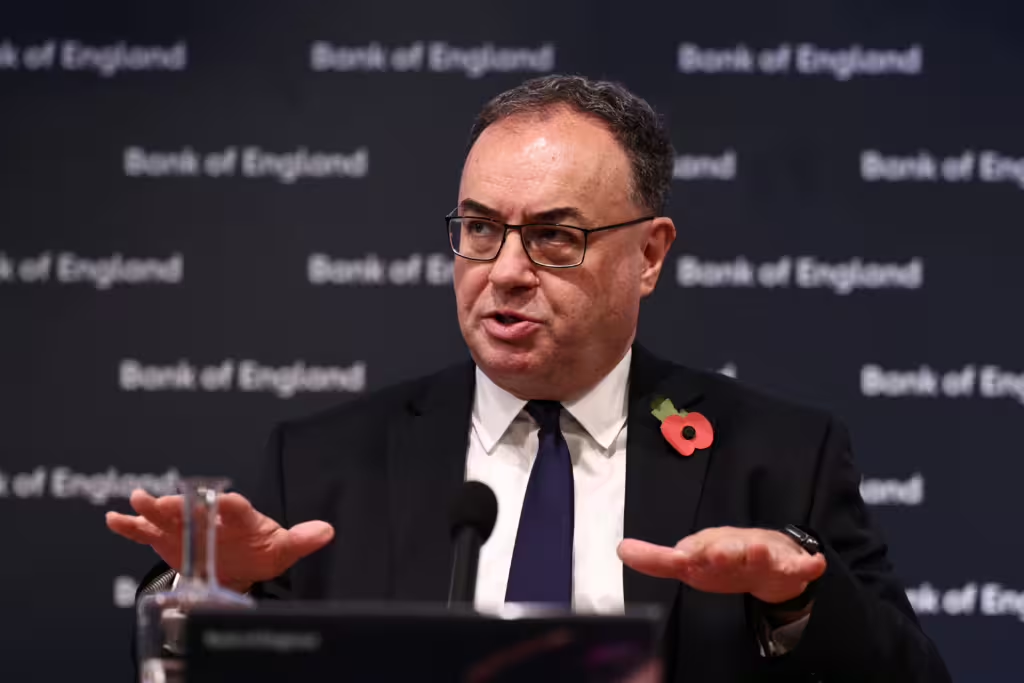
Governor Andrew Bailey has been a vocal figure in this debate, warning that unregulated stablecoins could “undermine trust in the monetary system.” The BoE previously proposed limits on stablecoin ownership, £20,000 for individuals and £10 million for businesses, in an effort to prevent excessive private dominance.
However, recent reports suggest the Bank is reconsidering its hardline stance, potentially allowing exemptions for select businesses that meet transparency and reserve standards.
Bailey’s tone has also shifted. In a recent essay, he stated that it would be “wrong to oppose stablecoins as a matter of principle,” acknowledging their potential to drive payment innovation both domestically and internationally. His nuanced position reflects the central bank’s pragmatic shift, one that recognises stablecoins’ utility while striving to contain systemic risks.
The challenge now lies in regulating without stifling innovation, ensuring that stablecoins complement, rather than compete with, sovereign money.
Tokenised Deposits: The Middle Ground
As the BoE weighs stablecoins against CBDCs, a third model is gaining traction, tokenised bank deposits.
These digital instruments represent deposits held at regulated banks, recorded on distributed ledgers but backed by traditional reserves. Unlike stablecoins, they do not remove money from the banking system. Instead, they extend the existing fractional reserve model into the digital domain, preserving the link between commercial banks and the real economy.
Governor Bailey has championed this concept as a “safe innovation bridge”, arguing that tokenised deposits combine the programmability and efficiency of stablecoins with the stability and oversight of traditional banking.
Globally, this hybrid model is gaining support. The Reserve Bank of India (RBI), typically cautious on private digital assets, has signalled openness to tokenised deposits, marking a notable shift in policy direction.
In the UK, the BoE’s latest research indicates a future multi-tiered ecosystem, where CBDCs, stablecoins, and tokenised deposits coexist under a common regulatory framework. Such interoperability, officials argue, could unlock innovation while maintaining financial stability.
Building a Unified Digital Money Ecosystem
The BoE’s ultimate goal appears to be interoperability, a seamless system where public and private forms of digital money can function together.
This approach reflects a growing recognition that plurality, not monopoly, will define the next era of finance. The challenge will be ensuring that private innovation does not fragment the monetary system or weaken central bank control over liquidity and stability.
While the debate remains unresolved, one thing is clear: the BoE’s measured, consultative approach stands in stark contrast to the ideological fervour surrounding digital currencies elsewhere. It seeks to preserve the public’s trust in money, the foundation of any economy, while cautiously embracing the technologies shaping its future.
Conclusion: Balancing Innovation and Sovereignty
As global financial systems digitise at unprecedented speed, the Bank of England finds itself balancing innovation with responsibility. Stablecoins have proven their value in efficiency and accessibility, but they also challenge the traditional architecture of monetary control.
The digital pound represents one possible answer, but not the only one. Through a combination of CBDCs, regulated stablecoins, and tokenised deposits, the BoE envisions a future where innovation coexists with oversight, and where money, in whatever form it takes, continues to serve the public good.
In the race toward digital finance, the BoE’s cautious yet adaptive stance may prove to be the most sustainable path forward, one that redefines not only the future of the pound but also the principles of financial sovereignty in a digital age.
Leave a Reply