
Spot Bitcoin (BTC) and Ether ETFs faced notable outflows on Friday after new US inflation data showed a pickup in price pressures. The Federal Reserve’s preferred measure of core inflation ticked higher, partly driven by President Donald Trump’s new tariff regime, putting pressure on risk assets.
Inflation Jumps as Tariffs Bite
The US Federal Reserve reported that the core Personal Consumption Expenditures (PCE) index rose at an annualised 2.9% in July. This marked the highest reading since February and highlighted persistent price pressures in the economy.
While the figure matched forecasts, analysts noted that the rise was tied to the Trump administration’s broad tariffs on imports. The White House has introduced a baseline 10% tariff on all imported goods, with additional duties targeted at specific categories. These measures have lifted import costs, feeding into higher service sector prices, which climbed 3.6% year-on-year.
Energy costs provided some relief, preventing headline inflation from climbing further, but the broader trend suggests tariffs are placing upward pressure on the cost of living.
Bitcoin ETFs See First Daily Loss in a Week
The higher inflation print coincided with significant outflows from Bitcoin ETFs. According to SoSoValue data, net withdrawals reached $126.64 million, the first daily loss for the asset since 22 August. Total Bitcoin ETF assets under management (AUM) slipped to $139.95 billion.
Fidelity’s FBTC led the downturn with a $66.2 million single-day outflow. ARK Invest and 21Shares’ joint ARKB product followed closely with a $72.07 million withdrawal. Grayscale’s GBTC also suffered, losing $15.3 million.
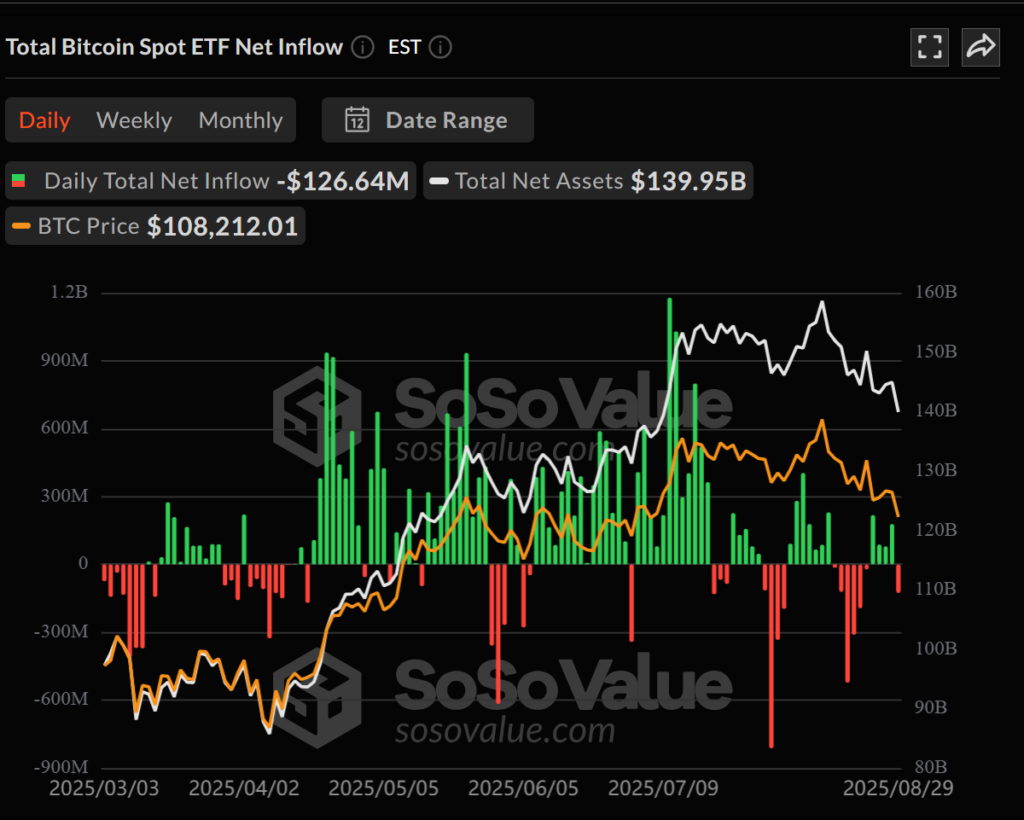
Only a few Bitcoin funds bucked the trend. BlackRock’s IBIT recorded a $24.63 million inflow, while WisdomTree’s BTCW added $2.3 million. Still, the broader direction was firmly negative, reflecting investor caution in response to higher inflation pressures.
Ether ETFs Reverse Strong Inflows
Ethereum ETFs also turned negative, breaking a five-day streak of gains. Net outflows reached $164.64 million on Friday, reducing momentum after more than $1.5 billion in cumulative inflows earlier in the week.
Total Ethereum ETF AUM fell to $28.58 billion, highlighting the immediate market reaction to the inflation data. This setback comes despite strong August growth, when Ether ETF inflows rose 44% from $9.5 billion to $13.7 billion.
The recent rally had been supported by growing institutional interest and corporate treasury allocations. Companies now collectively hold around 4.4 million ETH, worth more than $19 billion, equal to about 3.7% of total supply.
Rate Cuts Still on the Table
Despite the hotter inflation data, markets continue to expect the Federal Reserve to consider cutting interest rates at its next meeting. Investors point to signs of labour market weakness, which could give policymakers room to ease policy even as tariffs push prices higher.

Fabian Dori, chief investment officer at Sygnum, noted that Ethereum’s recent gains mark a shift in sentiment after months of underperformance against Bitcoin. “After an extended period of underperformance relative to Bitcoin and a souring investor sentiment, Ethereum has recently experienced a significant revival in the recognition of both its adoption rate and value proposition,” Dori said.
For now, however, the pressure of rising import costs and persistent inflation may limit the appetite for risk assets such as Bitcoin and Ethereum. ETFs that had seen steady inflows over the summer are now showing vulnerability to macroeconomic shifts.
The combination of Trump’s tariffs and firmer inflation data has injected volatility into the cryptocurrency ETF market. Both Bitcoin and Ether ETFs saw sharp outflows on Friday, underlining how sensitive digital asset funds remain to broader economic signals.
While Ethereum adoption continues to grow among corporates and institutions, and Bitcoin maintains its position as the largest crypto ETF market, inflationary headwinds are proving a challenge. Much now depends on how the Federal Reserve balances its response to inflation with concerns about slowing growth.
Leave a Reply