
A newly disclosed bug in Bitcoin Core versions 30.0 and 30.1 has prompted developers to pull recent releases after discovering that certain wallet migrations could lead to the deletion of local wallet files and permanent loss of funds. While the issue affects a narrow set of users, its discovery has reignited concerns around software concentration within the Bitcoin ecosystem.
What the wallet migration bug is about
Bitcoin Core developers issued a warning on Monday about a flaw tied to wallet migration logic introduced in versions 30.0 and 30.1. The bug appears when users attempt to migrate very old, unnamed legacy wallets that have never been upgraded or renamed.

Under specific conditions, the migration process can mistakenly delete the entire wallet directory on a user’s machine. If the affected user does not have an external backup, access to the funds stored in those wallets is effectively lost.
The problem does not impact the Bitcoin network’s consensus rules or block validation. However, it directly affects local wallet data, making it a serious concern for individuals running older setups.
How the issue gets triggered
According to Lacie Zhang, a market analyst at Bitget Wallet, the bug is activated when Bitcoin Core attempts to migrate an unnamed legacy wallet file, typically the default wallet.dat, that is stored in a custom wallet directory.
This setup is often created using the “-walletdir” configuration option. The risk increases further if pruning is enabled on the node. In these cases, the migration process may appear to complete successfully, but a cleanup routine incorrectly removes the entire wallet directory instead of just temporary files.
As a result, all locally stored wallet data can be wiped. Without an external backup, users are left with no way to recover their funds.
Zhang noted that this combination of conditions is uncommon but dangerous. Risk is highest when users are running Bitcoin Core v30.0 or v30.1, using a legacy wallet that was never upgraded, operating with pruning enabled, and storing wallets in a custom directory.
Who is most affected and who is not
The bug primarily impacts users with very old Bitcoin Core wallet setups. Shawn Odonaghue, community lead at layer-3 blockchain Orbs, said the issue is unlikely to affect people using modern wallet software or hardware wallets.
Most everyday Bitcoin holders today rely on wallets that do not depend on local wallet.dat files or that have already undergone several upgrade cycles. Those users are largely insulated from this specific risk.
However, long-time Bitcoin users who have maintained the same local wallet for many years, especially node operators who customized their directory structure, face higher exposure.
Developers pull releases and prepare a fix
Bitcoin Core version 30.1 was released on Jan. 1. Following the public disclosure of the migration bug, developers removed both version 30.0 and 30.1 binaries from the official download site.
The project advised users not to use wallet migration tools until a patched release, Bitcoin Core 30.2, becomes available. Users who are already running affected versions but are not attempting any wallet migration can continue operating their nodes as usual.
For technically experienced users, Zhang suggested several steps to assess exposure. These include checking the Bitcoin Core version in use, confirming whether the wallet is a legacy wallet, reviewing the debug.log file to see if pruning is enabled, and verifying whether a migration attempt has already taken place.
She emphasized that users who have not yet migrated should immediately back up their entire data directory to external storage and avoid restarting or upgrading until version 30.2 or later is released.
Concentration risk in the Bitcoin ecosystem
According to data from Coin Dance, Bitcoin Core currently powers about 78 percent of reachable Bitcoin nodes. Other implementations, such as Bitcoin Knots, account for most of the remainder.
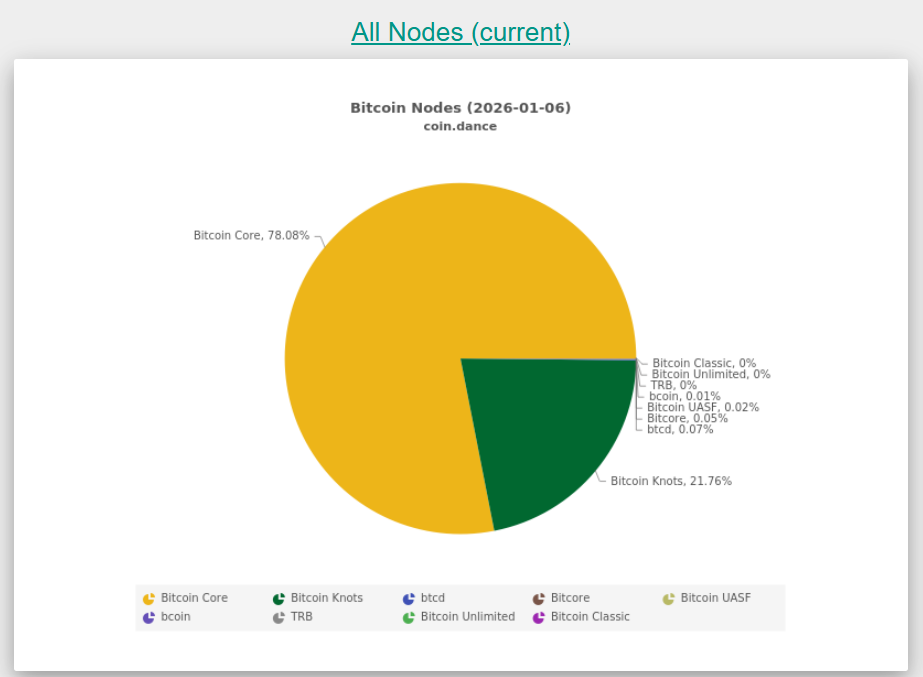
This dominance means that even bugs affecting a limited subset of users can have broader implications. While the current issue is not consensus critical, it highlights the systemic risk that comes with reliance on a single dominant software implementation.
Odonaghue pointed out that Bitcoin Core’s position as the default client amplifies the impact of any flaw or design decision. With few mainstream alternatives in widespread use, problems in Bitcoin Core can ripple through the ecosystem more easily than many users expect.
Zhang echoed that sentiment, noting that wallet-layer issues can still scale into ecosystem-wide concerns when one implementation dominates usage, even if the underlying protocol remains unaffected.
Leave a Reply