
Bitcoin experienced a sharp decline of 2.7% over the past 24 hours, dropping from above $111,000 to $105,150, as multiple market indicators pointed towards waning investor demand and intensified sell-side pressure. The drop coincided with significant long position liquidations and growing concerns over macroeconomic conditions, including US-China trade tensions.
Institutional Outflows Weigh on Bitcoin
One of the primary drivers behind Bitcoin’s latest dip has been the notable outflows from spot Bitcoin ETFs. On May 29 alone, spot BTC ETFs recorded $358.65 million in outflows, marking the end of a 10-day streak of net inflows. Such a reversal in institutional investment flows signals a potential cooling of interest from large-scale investors, contributing to bearish sentiment.
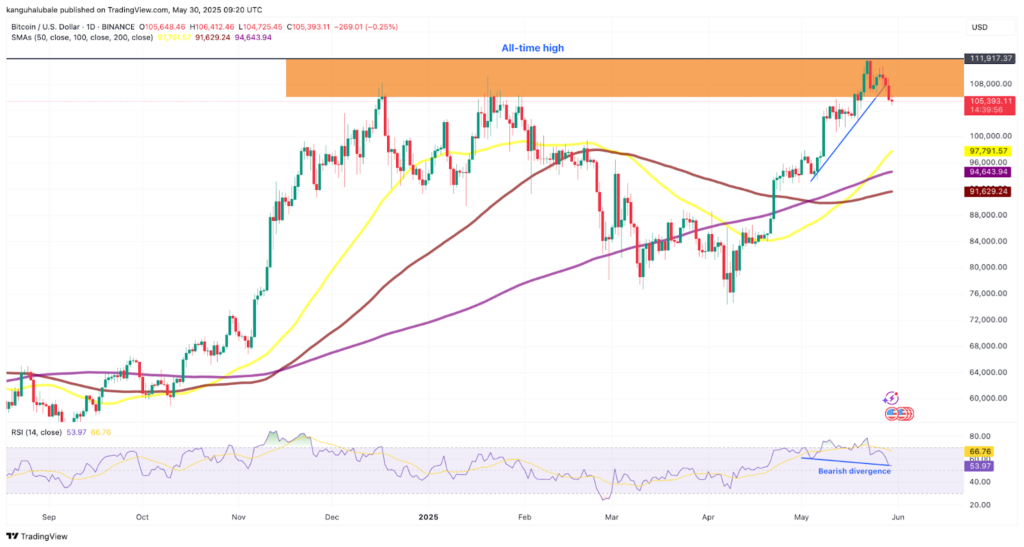
These ETF outflows have coincided with a noticeable drop in Bitcoin’s upward momentum following its recent surge to an all-time high above $111,000. Analysts suggest that this pullback is indicative of a broader shift in investor behaviour, with some choosing to secure profits and step back from the market.
Long Position Liquidations Amplify Downward Pressure
Adding to the decline, the derivatives market saw a wave of long position liquidations. In the past 24 hours, over $211 million in long Bitcoin positions were liquidated, compared to just $10.8 million in short positions. Within the last 12 hours alone, over $114 million in longs were wiped out. Across all cryptocurrencies, more than $680 million in leveraged positions have been liquidated in a single day.
These liquidations suggest that bullish traders were caught off guard by the price drop, forced to exit their positions and further drive down the price in a cascading effect. The scale of these liquidations is comparable to the April 5–6 period, when over $280 million in long positions were cleared amid an 8.5% drop in Bitcoin’s price.
RSI Divergence Signals Buyer Exhaustion
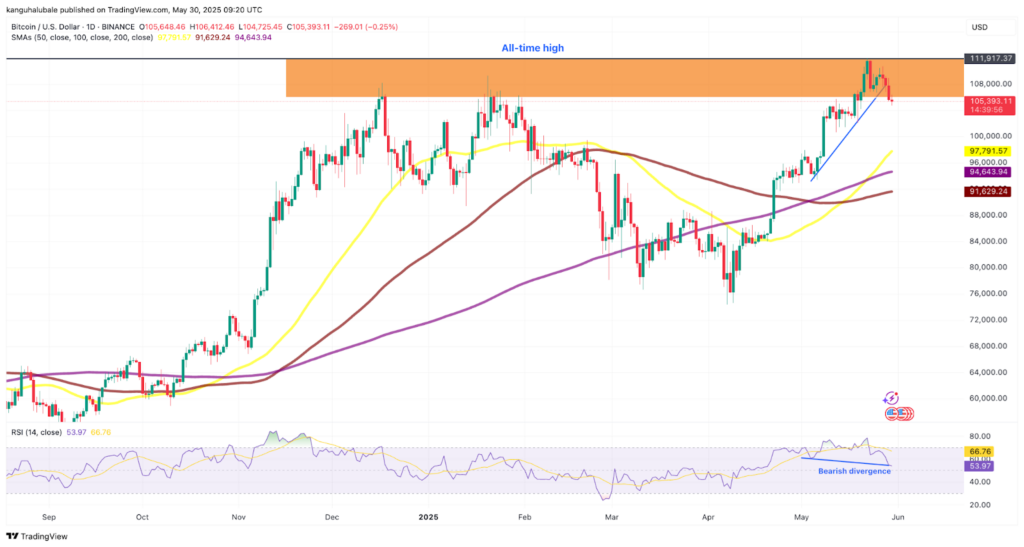
Technical indicators have also flagged a potential weakening in Bitcoin’s recent bullish trend. A bearish divergence has emerged between the price action and the Relative Strength Index (RSI). While Bitcoin’s price was making higher lows between May 5 and May 28, the RSI fell from 76 to 54, indicating diminishing buying strength.
Such divergence typically suggests that a rally may be running out of steam. As profit-taking increases, buyer exhaustion sets in, leading to potential pullbacks or extended periods of consolidation. Popular crypto analyst Willy Woo has echoed this observation, warning that failure to break past current resistance levels could see Bitcoin’s price sink further in the short term.
Whale Activity Hints at Slowing Demand
Further analysis by CryptoQuant reveals that Bitcoin’s 30-day demand growth peaked at 229,000 BTC on May 28 — close to the December 2024 high of 279,000 BTC. Historically, such peaks have marked local tops in the market.
Moreover, while the balances held by whale addresses have increased by 2.8% over the past month, the pace of accumulation has slowed. This often precedes a broader decline in whale interest, suggesting a potential pause in the ongoing rally.
Consolidation or Correction?
Despite the drop, some analysts believe Bitcoin may simply be entering a “healthy pause.” With its current price hovering around $105,000–$106,000, the cryptocurrency might consolidate before the next significant move. Market observers remain divided, with some projecting a further correction, while others believe this could be a stepping stone towards a larger upward move potentially targeting the $220,000–$330,000 range.
Until a clear trend emerges, traders and investors will be watching closely for signs of renewed buying interest or further institutional outflows, which could determine Bitcoin’s short-term direction.
Leave a Reply