
Bitcoin may be significantly undervalued, with new analysis indicating its fair price should be almost 45 percent higher than current levels. According to Charles Edwards, founder of crypto asset manager Capriole Investments, the Energy Value metric places Bitcoin’s true value at approximately $167,800 per coin.
Bitcoin trading 31 percent below fair value
As of now, Bitcoin is priced around $116,000, but the Energy Value metric—developed by Capriole in 2019—suggests it should be trading closer to $167,800. The calculation is based on energy input from miners, the rate of supply growth and a constant representing the fiat dollar value of energy.
In a post on X, Edwards stated that the current Bitcoin price reflects a 31 percent discount compared to its energy-based valuation. This metric has previously aligned closely with long-term price trends and is now signaling that Bitcoin is cheaper relative to its value than at any time since September 2020, when it traded around $10,000.
Hash rate hits record high, supports valuation
One of the key indicators backing the Energy Value theory is Bitcoin’s hashrate, which represents the total computing power dedicated to mining. According to Glassnode data, the hashrate reached a new all-time high of 1.031 zettahashes per second (ZH/s) on August 4. This growing hash power indicates sustained or increasing energy input, reinforcing the idea that Bitcoin’s market price should trend upward to match this effort.
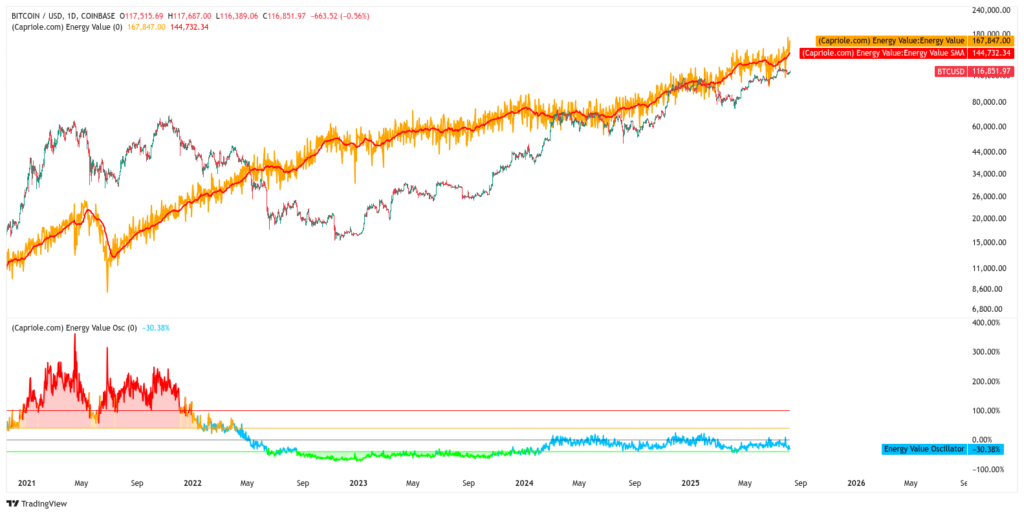
Edwards highlighted that the Energy Value’s simple moving average (SMA) recently touched $145,000. As the hashrate climbs, so too does the fair price derived from the Energy Value model.
Miners drive bullish outlook
The metric operates on the principle that consistent or rising energy input from miners reflects long-term demand and network health. If miners were to exit the network entirely, Bitcoin’s fair value would theoretically drop to zero. However, current network activity suggests the opposite is happening.
Capriole explains that rising prices typically attract more energy input through greater hash power and technological efficiency. This cycle supports higher valuations over time. But when prices surge without an accompanying increase in energy input, speculative bubbles can form and eventually collapse back to the Energy Value.
Limited time for price to catch up
With many analysts predicting that the current Bitcoin bull market has only a few months left, there may be limited time for the market to align with the Energy Value. If miners continue investing energy into the network, the metric’s fair value may hold or rise. However, a slowdown in miner activity could reduce the Energy Value figure.
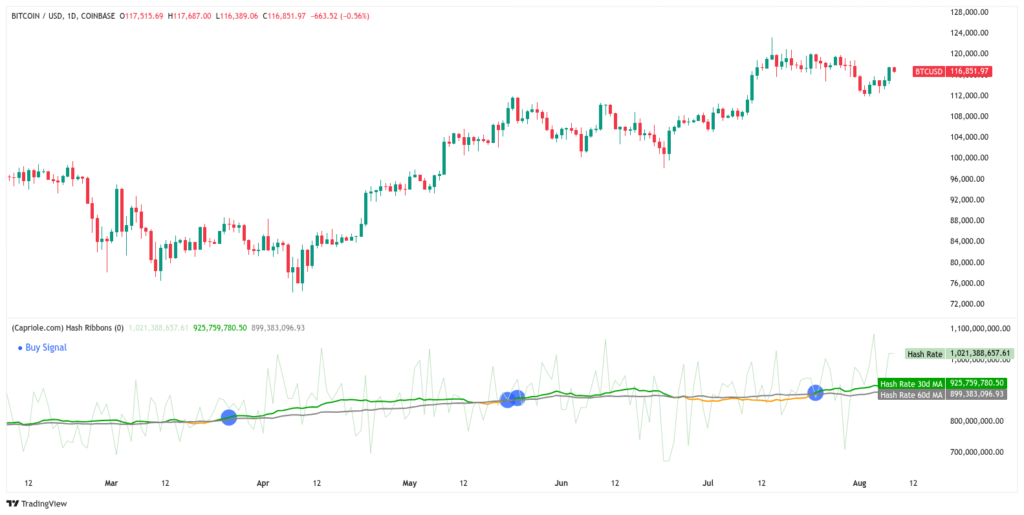
Despite short-term volatility, the Hash Ribbons indicator—another widely followed metric—recently flashed a buy signal in late July, suggesting positive momentum for both miners and overall price movement.
The Energy Value approach provides a grounded framework for long-term valuation, contrasting the more speculative price action often seen during Bitcoin rallies. As hash power climbs and network strength increases, the case for a higher Bitcoin price becomes stronger—at least according to the energy-based model.
Leave a Reply