
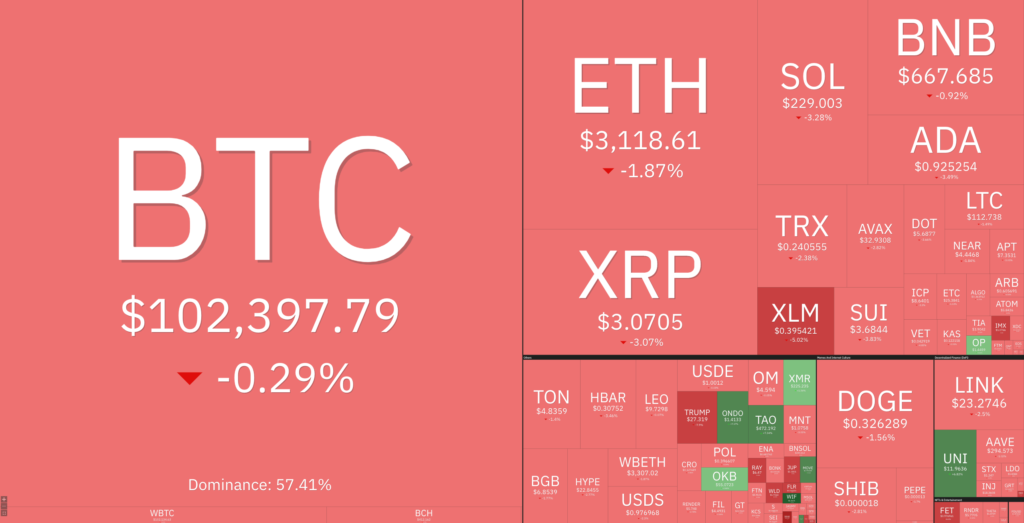
The cryptocurrency market experienced a significant downturn on 7 February, with total market capitalisation dropping by over 2.5% to approximately $3.15 trillion. While market volatility is common in the crypto space, several key factors have contributed to this latest decline, including investor caution ahead of US jobs data, liquidations, and weakening technical indicators.
Ethereum Leads Market Slump
The current market downturn is part of a correction that began on 31 January, following an executive order from US President Donald Trump imposing tariffs on imports from Mexico, Canada, and China. The decline has extended into February, with Ethereum (ETH) leading losses among major cryptocurrencies.
ETH has fallen by 5% in the past 24 hours, trading just below $2,700. Meanwhile, Bitcoin (BTC) saw a 1.3% drop, hovering around $96,800. Other top-cap cryptocurrencies also faced declines: Solana (SOL) fell by 6.3%, Dogecoin (DOGE) by 6.5%, and Cardano (ADA) by 6%.
Market Liquidations Weigh on Prices
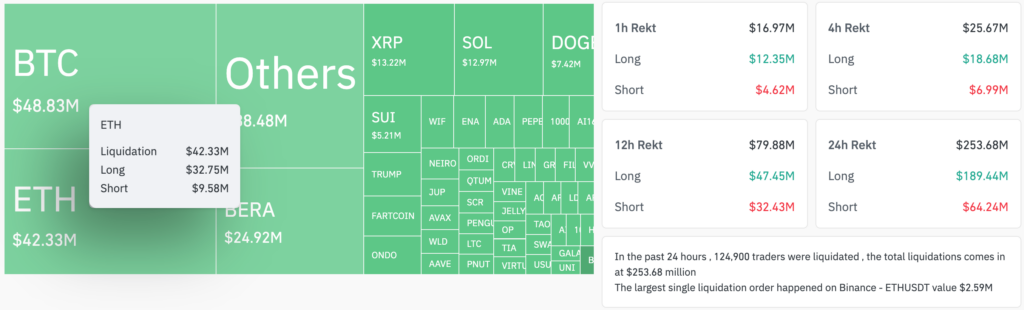
A wave of liquidations has further exacerbated the market decline. Over $250 million in crypto liquidations were recorded in the past 24 hours, as leveraged positions were wiped out. Notably, long ETH leveraged positions worth $32.75 million were liquidated, slightly surpassing the $32.2 million in BTC liquidations.
More than 124,900 traders faced liquidations, with the largest single event occurring on Binance, where an ETH/USDT trade worth $2.59 million was closed. The prevalence of long liquidations suggests that the market had been overleveraged on the bullish side.
Investors Await US Jobs Data
Adding to market uncertainty is the upcoming release of US jobs data on Friday, 7 February. Investors remain on edge, anticipating key indicators such as job openings, unemployment rates, and wage growth, which could influence the Federal Reserve’s stance on interest rates.
Market analysts forecast a decline in job openings to 170,000 from December’s 256,000. The unemployment rate is expected to hold steady at 4.1%, while average hourly earnings are projected to rise by 0.3% month-on-month, mirroring December’s pace.
According to The Kobeissi Letter, there is a 28% probability that over 300,000 jobs were added in January—far exceeding Wall Street’s median estimate of 170,000. If this projection holds, it would mark the first instance of such growth since March 2024.
A weaker-than-expected jobs report could prompt a more dovish stance from the Federal Reserve, potentially leading to faster rate cuts. This scenario might renew demand for risk assets like stocks and Bitcoin. At present, there is an 85.5% chance that the Fed will keep interest rates unchanged at its 19 March meeting, while the likelihood of a rate cut in June stands at 44.8%.
Market Technicals Show Signs of Weakness
From a technical perspective, the total cryptocurrency market capitalisation (TOTAL index) is currently testing a key support level at $3.11 trillion, marking the lower boundary of a bull flag pattern.
The index briefly fell below this boundary, raising concerns that a deeper correction may be on the horizon. Should this support level fail to hold, analysts expect a retest of the 50-day simple moving average (SMA) at $2.55 trillion. A further drop could push TOTAL back to the start of the flagpole at $2.25 trillion, marking a 27% decline from current levels.
The daily relative strength index (RSI) has sharply declined from its December overbought level of 78 to a current reading of 48, indicating that bears currently hold the upper hand in the market.
A Strategic Buying Opportunity?
Despite the prevailing market uncertainty, some analysts view the current downturn as a potential buying opportunity. Popular crypto analyst Crypto Zone noted that the Fear and Greed Index is now in the “fear zone” at 35. Historically, periods of fear have been followed by market recoveries, presenting an opportunity for long-term investors.
While short-term volatility may persist, market participants will be closely watching economic data and central bank policy moves to gauge the next major trend in the cryptocurrency market.
Leave a Reply