
Binance co-founder advocates for enhanced trade privacy amid rising concerns over front-running and liquidation targeting
Binance co-founder Changpeng “CZ” Zhao has proposed the development of a decentralised exchange (DEX) with dark pool features specifically for perpetual swaps. His suggestion aims to tackle market manipulation issues such as front-running and MEV (Maximum Extractable Value) attacks, which he argues disproportionately affect large-scale traders.
In a post on social media platform X on 1 June, Zhao questioned the logic behind the full transparency of orders on DEXs, especially in the case of perpetual futures trading. “I have always been puzzled with the fact that everyone can see your orders in real-time on a DEX,” Zhao wrote.
Targeting Front-Running and MEV Attacks
The former Binance CEO highlighted the vulnerability of large orders in decentralised finance (DeFi), stating that public visibility can lead to exploitative tactics. “If you’re looking to purchase $1 billion worth of a coin, you generally wouldn’t want others to notice your order until it’s completed,” Zhao explained. He warned that front-running bots and MEV attackers can exploit these transactions, resulting in significant slippage and increased trading costs.
His comments come shortly after the reported liquidation of nearly $100 million in Bitcoin long positions held by a trader known as James Wynn on Hyperliquid. The liquidation, triggered when Bitcoin fell below $105,000, has fuelled speculation about potential coordination among traders to “hunt” Wynn’s position.
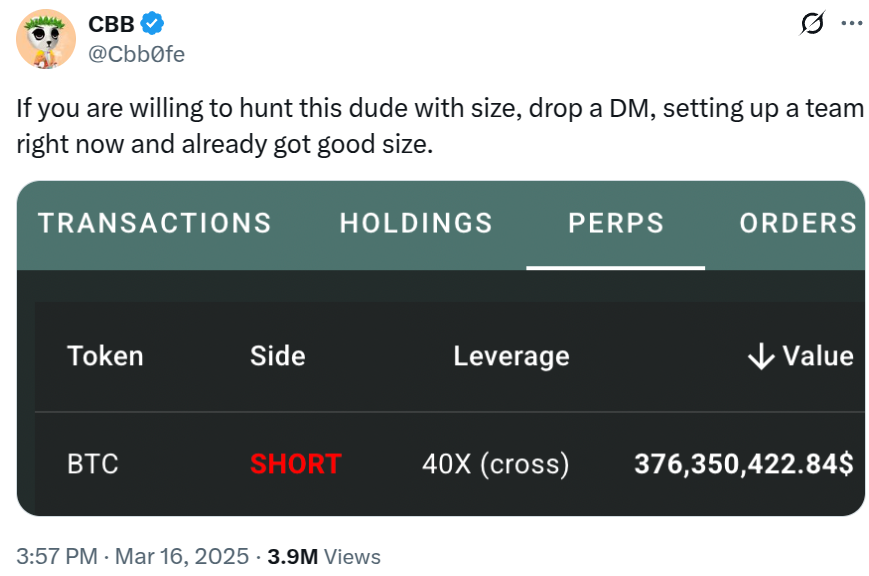
Some users on X even alleged that Tron founder Justin Sun expressed interest in the event, though these claims remain unverified. One user went so far as to suggest that Eric Trump, son of U.S. President Donald Trump, had been invited to the group involved.
Understanding Dark Pools in Trading
Dark pools are private trading venues used primarily in traditional finance (TradFi) to enable large trades without revealing order size, price, or intent until after execution. Zhao noted that “large traders in TradFi use dark pools, often 10 times bigger” than transparent pools, to avoid slippage and manipulation.
In a decentralised context, however, implementing such privacy-focused systems presents unique challenges. Maria Carola, CEO of instant crypto exchange StealthEX, acknowledged that “the fundamental challenge in building a dark pool-style perp DEX is achieving both privacy and verifiability.” She cited the use of zero-knowledge proofs (ZK-proofs), including zk-SNARKs and zk-STARKs, as promising technologies to enable secure, private order matching while maintaining accountability.
“Trade execution and settlement must be validated without exposing sensitive trade details,” Carola added.
Privacy in Derivatives Markets Is Crucial
Zhao particularly emphasised the need for privacy in derivatives markets, where public liquidation levels can create new avenues for manipulation. “If others can see your liquidation point, they could try to push the market to liquidate you. Even if you got a billion dollars, others can gang up on you,” he said.
While Zhao acknowledged that some traders may prefer transparent systems—arguing that visibility can allow market makers to absorb large orders—he maintained that different market structures suit different trading strategies. “I won’t get into an argument on which is right or wrong. Different traders may prefer different types of markets,” he said.
Carola echoed a similar sentiment, noting that while “opacity reduces front-running,” it also “obscures manipulation attempts, especially in a leveraged environment.” She argued that any dark pool DEX must include “adaptive risk engines and behavioural anomaly detection,” along with cryptographic accountability mechanisms.
Call to Action for Developers
Zhao concluded his proposal by urging developers to take on the challenge of launching an onchain dark pool DEX for perpetual swaps. He suggested this could be done by “not showing the orderbook, or even better, not showing deposits into smart contracts at all, or until much later.”
While the idea is in its early stages, Zhao’s comments have sparked renewed interest in the feasibility of privacy-first decentralised trading platforms. As the DeFi ecosystem matures, balancing transparency, privacy, and regulatory compliance remains one of the industry’s greatest hurdles.
Leave a Reply