
Ethereum ETFs have experienced one of their sharpest reversals since launch, with over $500 million leaving in just a few days. Despite the outflows, institutional investors appear undeterred, continuing to buy ETH directly and reinforce confidence in its long-term value.
A Wave of Withdrawals
On September 5, U.S. spot Ethereum ETFs saw net outflows of $446.71 million, the second-largest single-day withdrawal since these products debuted earlier this year. The move capped a four-day streak of redemptions starting on August 29, when flows turned negative after months of steady demand.
The breakdown shows the scale of the retreat:
- August 29: $164.64 million left Ethereum ETFs.
- September 2: $135.37 million flowed out.
- September 3: $38.24 million was withdrawn.
- September 5: A record $446.71 million exit.
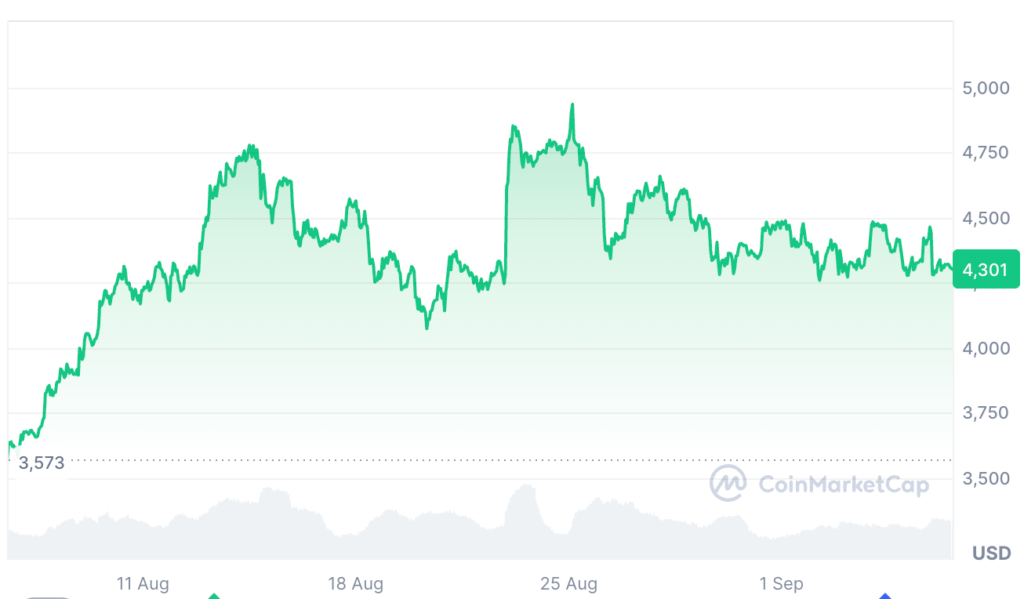
In total, more than half a billion dollars has left Ethereum ETFs in under a week. The sell-off also weighed on ETH itself, which closed at $4,300, marking a 1.7% decline over the week.
BlackRock, Fidelity and Grayscale Take the Hit
The biggest blow fell on BlackRock’s ETHA, which recorded $309.88 million in outflows on September 5 alone, according to SoSoValue data. Fidelity’s FETH was also hit, losing $37.77 million, while Grayscale’s ETHE and ETH products saw a combined $72.59 million exit.
21Shares’ ETHX was not spared either, with $14.68 million withdrawn. By contrast, funds from Bitwise, VanEck, Franklin and Invesco reported no net flows for the day, suggesting the pressure was concentrated on the larger issuers.
Despite these losses, Ethereum ETFs collectively still hold $33.82 billion in assets, representing 3.06% of Ethereum’s total market value. Since their launch, they have attracted cumulative inflows of $12.81 billion, showing that longer-term institutional participation remains intact.
Sentiment Cools, but Buyers Step In
The string of withdrawals highlights how ETF flows can swing sharply in response to short-term sentiment shifts. Outflows are often linked to profit-taking, macroeconomic pressures like interest rates, or shifts in the U.S. dollar’s strength.
Yet, even as ETFs bled capital, large investors stepped in. Bitmine bought more than 150,000 ETH in two sizeable transactions, while SharpLink Gaming and The Ether Machine also expanded their holdings. These moves indicate that institutions remain confident in Ethereum’s long-term trajectory, even if near-term flows suggest caution.
What It Means for Ethereum
While the recent redemptions mark a setback, they do not necessarily reflect a collapse in confidence. Instead, they show how ETF investors often trade tactically, responding to market momentum and macro conditions, while larger institutions accumulate during dips.
Analysts note that the dual trend, ETF outflows alongside direct institutional buying reflects a maturing market. Retail and short-term traders may move in and out of ETFs quickly, but institutional investors continue to view Ethereum as a key digital asset with long-term potential.
If ETH maintains strong institutional backing, the outflows could prove temporary, much like the fluctuations seen in Bitcoin ETFs earlier this year. As Ethereum continues to hold over 3% of its market cap in ETF products, its role in bridging traditional finance and decentralised markets appears secure.
Ethereum ETFs are facing a turbulent start to September, but the broader picture remains positive. The heavy outflows highlight how fragile sentiment can be, especially after months of inflows, yet the steady hand of institutions provides balance.
With ETH still supported by major funds and direct buyers, the market appears to be in a consolidation phase rather than a breakdown. If broader macroeconomic conditions stabilise, ETFs could return to inflow mode, strengthening Ethereum’s foothold in traditional financial markets.
Leave a Reply