
The Ethereum Foundation has allocated $120 million worth of Ether (ETH) to decentralised finance (DeFi) protocols, marking a significant shift in its financial strategy. The move, which saw 45,000 ETH deployed across Aave, Spark, and Compound, has been widely welcomed by the community, particularly as it reduces the need for the foundation to sell ETH for operational funding.
Major Allocation to DeFi
On 13 February, the Ethereum Foundation’s multisignature wallet deposited 4,200 ETH into Compound, 10,000 ETH into Spark, and 30,800 ETH into Aave. With ETH trading at around $2,600, the total value of these transactions amounted to approximately $120.4 million.
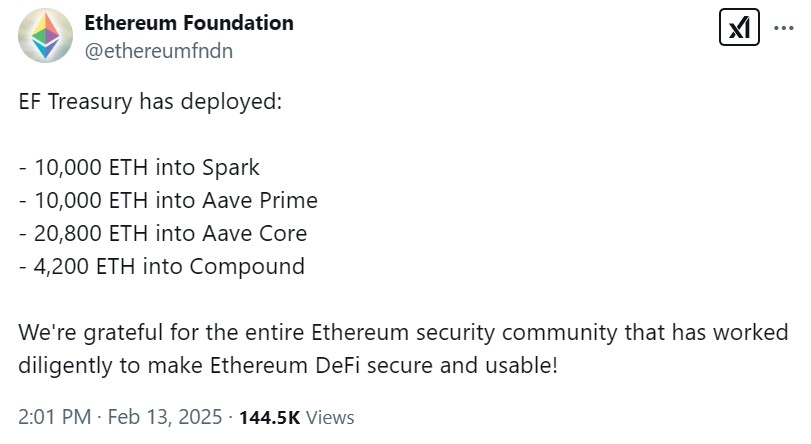
Aave founder and CEO Stani Kulechov described the foundation’s $82.4 million contribution to Aave as its “biggest allocation in DeFi.” He expressed optimism about the move, declaring, “DeFi will win.” The infusion of funds is expected to add liquidity to the DeFi ecosystem, strengthening its position within the broader Ethereum network.
Community Reactions
The decision has been met with widespread approval from community members and industry leaders. Podcaster Mark Jeffrey called the move “smart,” highlighting that lending is at the core of DeFi, with Aave being the “beating heart of lending.”
An X (formerly Twitter) user praised the foundation’s approach, calling it a sign that their advocacy was making an impact and urging the community to “keep it up.” Another user described it as “a positive thing,” suggesting that the foundation should continue managing its funds in a similar manner.
Meanwhile, 0xNessus, the pseudonymous co-founder of lending protocol HyperLend, noted that it was surprising the Ethereum Foundation had only just begun engaging with DeFi applications after years of operation. “All we had to do was bully them,” they remarked, suggesting that community pressure had played a role in influencing the decision.
Criticism Over ETH Sales
The foundation’s shift towards DeFi comes after it faced criticism in January for selling ETH to cover operational expenses and staff payments. Ethereum Improvement Proposal (EIP-1559) co-author Eric Conner had previously accused the foundation of using ETH primarily for “dumping” rather than strategic growth.
Similarly, Anthony Sassano, host of The Daily Gwei, had suggested that the foundation could have staked ETH on Aave and borrowed stablecoins against it, rather than selling its holdings outright—a move that many in the community believe negatively impacts ETH’s price.

Ethereum co-founder Vitalik Buterin previously addressed concerns about staking, citing regulatory uncertainty and the risk of being forced into a specific position in the event of a future Ethereum hard fork.
Looking Ahead
Despite past criticisms, the Ethereum Foundation has signalled that this latest deployment is just the beginning. In a statement, the organisation teased that there is “more to come” and invited the community to offer suggestions on staking and fund management.
This shift towards active participation in DeFi marks a new chapter for the Ethereum Foundation, potentially setting a precedent for future fund allocations while reinforcing the decentralised finance ecosystem.
Leave a Reply