
TeraWulf, once known solely as a Bitcoin mining firm, is rapidly reshaping itself into a hybrid digital infrastructure provider. With Google stepping in to backstop billions in commitments, the company is chasing scale in one of the hottest sectors of 2025: AI-ready data centres. The bold strategy has excited Wall Street while also fuelling sharp volatility in TeraWulf’s shares.
$3B Morgan Stanley Deal in Motion
According to Bloomberg, TeraWulf plans to raise around $3 billion through Morgan Stanley in a high-yield bond or leveraged loan offering. The funds will be channelled into the build-out of large-scale data centres, part of the firm’s pivot away from reliance on crypto mining revenues.
Google has agreed to backstop the deal, providing crucial stability to the debt package, though the exact structure remains under negotiation. Credit rating firms are reportedly weighing grades in the BB to CCC range, highlighting the risk involved. Such debt instruments are typically reserved for companies with heavy existing leverage, reflecting both TeraWulf’s capital intensity and the market’s caution.

CFO Patrick Fleury confirmed the offering could launch as early as October. If successful, the deal would cement TeraWulf’s transition from miner to infrastructure operator in the AI era.
Google Commits $3.2B in Long-Term Support
Google’s involvement with TeraWulf is neither casual nor short-term. In August, the Big Tech firm agreed to backstop $3.2 billion of lease obligations tied to a ten-year, $3.7 billion colocation agreement with Fluidstack, an AI cloud infrastructure provider. That deal secured Google warrants equivalent to a 14% equity stake in TeraWulf, underscoring its long-term interest in the miner-turned-data-centre operator.
Thursday’s new financing builds directly on that foundation. Combined, the agreements reflect Google’s strategic bet on crypto miners’ unique advantage in the AI boom: access to power capacity and pre-existing infrastructure, both of which are in critical shortage.
Stock Volatility Shows Investor Caution
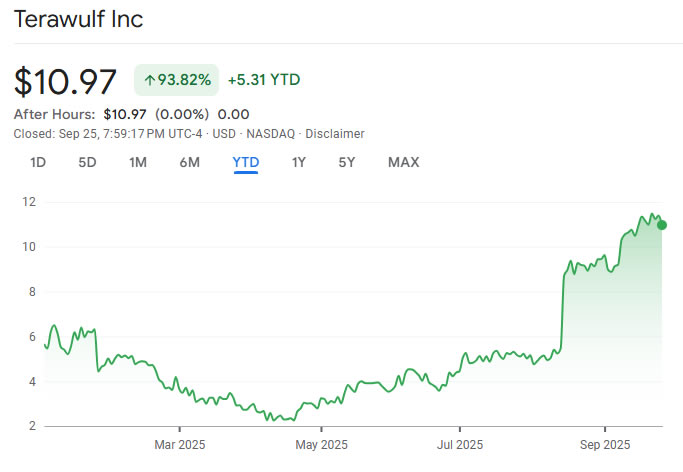
The market reaction has been anything but smooth. On Thursday, TeraWulf shares (WULF) spiked 12% intraday to $11.72 before retreating sharply to close at $10.97, a 3.7% decline in after-hours trading.
Since Google’s first backstop deal in August, WULF has been extremely volatile, with a Beta coefficient reported between 3.36 and 4.267. The stock jumped more than 80% after August’s announcement and is still up 94% year-to-date, but wide swings highlight investor unease about the debt-heavy strategy.
The risks are real. Data centre construction is notoriously prone to cost overruns, technical setbacks and competitive pressure. At the same time, the company must balance capital-intensive AI hosting against the more cash-generative, though volatile, Bitcoin mining side of its business.
A Sector-Wide Pivot
TeraWulf isn’t alone. Cipher Mining announced a parallel deal this week with Fluidstack, also supported by Google. The tech giant took a 5.4% stake in Cipher and committed to backstop $1.4 billion in obligations under its own colocation agreement.
This points to a broader trend: crypto miners, once locked into the volatility of Bitcoin, are repositioning themselves as infrastructure providers for the AI era. With their energy contracts and existing server farms, they are well placed to capitalise on shortages in compute and power supply.
Outlook: High Risk, High Reward
TeraWulf’s pivot is a classic spend-big-to-win-big gamble. If successful, it will emerge as a data centre heavyweight, capable of delivering multi-billion-dollar, long-term AI hosting contracts. But failure could leave it burdened with unsustainable debt and overextended infrastructure.
For now, Google’s backing provides credibility and financial cushioning, but investor sentiment remains fragile. As the October financing window approaches, WULF’s share price will continue to swing between bold optimism and wary caution.
Leave a Reply