
Usage Remains Strong After 2022
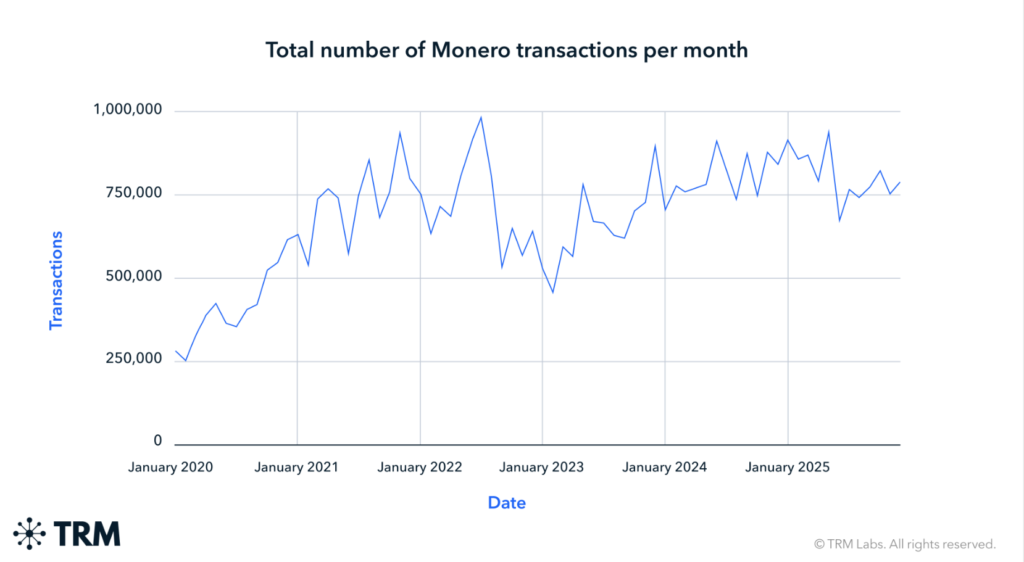
Monero continues to see steady transaction activity even after facing widespread delistings from major cryptocurrency exchanges. According to new research from TRM Labs, Monero usage in 2024 and 2025 stayed above levels recorded before 2022, indicating that demand for the privacy-focused cryptocurrency has not weakened.
The findings suggest that while access to Monero through regulated platforms has become more limited, users who rely on its privacy features have not abandoned the network.
Exchanges and Regulators Tighten the Screws
Pressure on Monero increased last year as leading exchanges began removing the asset from their offerings. In 2024, platforms such as Binance and Kraken moved to delist or phase out Monero, citing compliance and traceability concerns.
Regulatory scrutiny intensified further in 2025 when authorities in Dubai prohibited licensed platforms within the Dubai International Financial Centre from supporting privacy coins like Monero and Zcash. These measures significantly reduced Monero’s presence on mainstream exchanges, yet they did not translate into a clear drop in on-chain activity.
Bitcoin Still Dominates Ransom Payments
Despite Monero’s reputation as a privacy coin, Bitcoin remains the primary currency used for real-world ransom payments. TRM Labs notes that ransomware groups often request Monero and may even offer discounts for payments made in XMR. Even so, most victims continue to settle demands in Bitcoin, largely due to its liquidity and broader acceptance.
This contrast highlights a split in criminal usage patterns, where Monero is preferred in theory for anonymity, but Bitcoin remains dominant in practice.
Darknet Markets Shift Toward Monero
While ransom payments still favor Bitcoin, darknet marketplaces are moving in the opposite direction. Researchers found that 48 percent of newly launched darknet markets in 2025 supported only Monero. This represents a notable increase compared to earlier years, when many such platforms accepted multiple cryptocurrencies.
The trend suggests that operators of these markets are increasingly prioritizing privacy over convenience, especially as law enforcement agencies improve their ability to trace activity on more transparent blockchains.
Network Behavior Raises New Questions
Monero’s core cryptography continues to conceal the sender, recipient, and transaction amount. However, TRM Labs examined how transactions propagate across the network rather than focusing solely on the blockchain itself. Their analysis found that around 14 to 15 percent of Monero nodes displayed unusual behavior, including distinct timing patterns and clustering on specific servers.
This does not indicate that Monero’s encryption has been broken. Instead, it points to the possibility that some operators run multiple interconnected nodes capable of observing how transactions spread. In peer-to-peer networks, nodes that receive transactions earlier than others may gain clues about their origin, potentially weakening anonymity at the network level.
Software Update Targets Spy Nodes
In response to long-standing concerns, the Monero community released a software update in October 2025 known as Fluorine Fermi version 0.18.4.3. The upgrade introduced improvements to peer selection, helping wallets avoid suspicious areas of the network and connect with safer nodes.
The update aims to protect users from so-called spy nodes, which attempt to link transactions to IP addresses by monitoring network traffic rather than breaking cryptographic protections.
Debate around these risks has circulated for years, but attention increased after a leaked video in 2024 suggested investigators could observe activity by operating their own nodes. While Monero’s privacy features remain intact on-chain, the latest findings show that network-level behavior continues to be an important factor in assessing real-world anonymity.
Leave a Reply