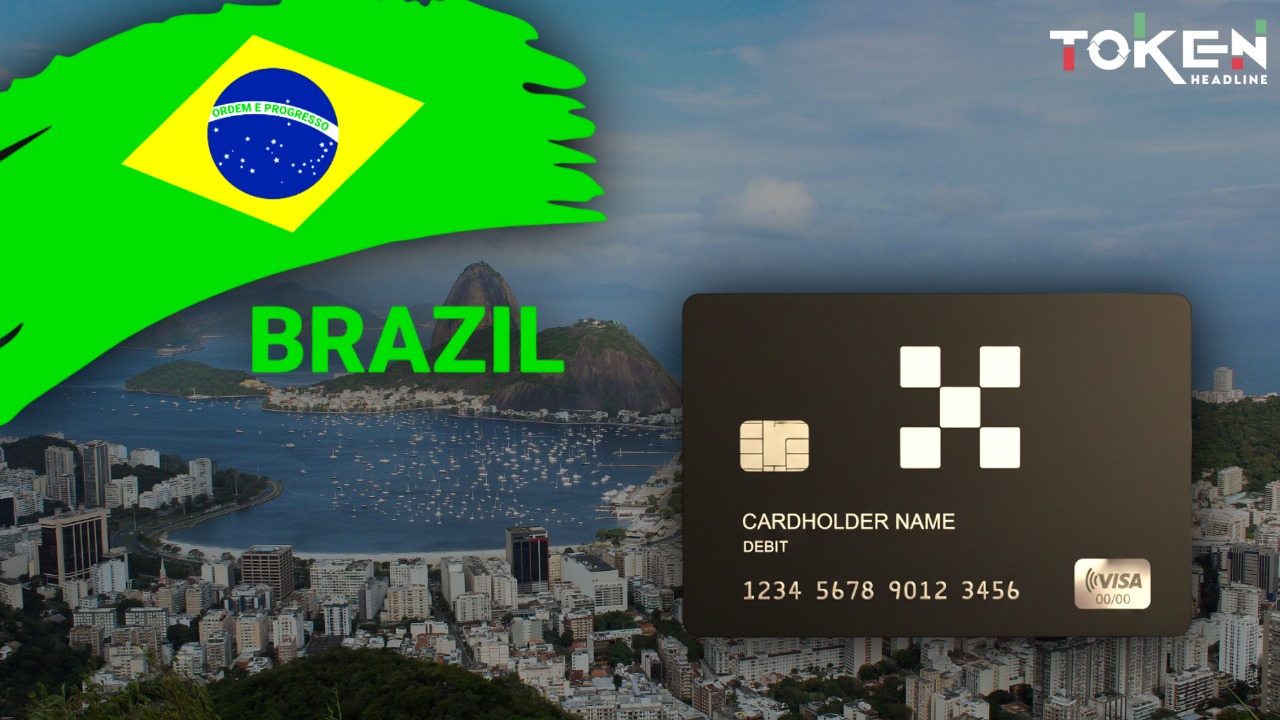
OKX, one of the world’s leading cryptocurrency exchanges, has entered the fast-growing crypto payments market with the launch of its first debit card in Brazil. The move positions OKX alongside major players such as Binance and Coinbase, both of which have already introduced crypto-linked payment cards across several regions.
The OKX Card, launched on November 6, operates through Mastercard and allows users to spend their digital assets anywhere the payment network is accepted. The card is denominated in USD, while top-ups can be made using Brazilian Reals (BRL), automatically converted into USD-pegged stablecoins.
Bringing Stablecoins into Everyday Spending
The launch marks a significant step in OKX’s effort to bridge the gap between digital assets and daily financial use. Users can now spend their stablecoin balances globally, whether online or at physical retail stores, using Apple Pay or Google Wallet.
In a market first for Brazil, the exchange has integrated its card with Pix, the country’s instant payment system, enabling near-instant top-ups from local bank accounts.
Balances held on OKX Pay, its companion app, can also earn up to 10% annual percentage yield (APY), calculated daily and paid weekly. With no foreign transaction taxes (IOF) or hidden conversion costs, OKX is positioning its offering as a cost-efficient way for Brazilians to access the global economy.
OKX Pay: The Foundation for Seamless Dollarisation
The card launch coincides with the rollout of OKX Pay, a stablecoin-centric payments platform built on OKX’s ZK-based X Layer blockchain. The service allows users to manage stablecoins as effortlessly as traditional bank accounts.
Through OKX Pay, customers in Brazil can:
- Instantly convert Brazilian Reais to digital dollars via Pix.
- Earn competitive interest rates on stablecoin balances.
- Transfer digital dollars globally, both domestically and internationally, with no delays.
- Enjoy a Brazilian-first user experience, featuring local support and simplified onboarding via digital KYC.
Together, OKX Pay and OKX Card aim to simplify crypto adoption by offering practical, fiat-integrated tools that appeal not only to crypto enthusiasts but also to the average consumer.
Visa vs. Mastercard: A Growing Divide Among Exchanges
The broader crypto card market remains evenly split between Mastercard and Visa, as exchanges weigh compliance requirements, capital commitments and flexibility.
Mastercard, known for its stricter regulatory standards, often demands larger liquidity buffers from partners anticipating high transaction volumes. Visa, on the other hand, provides more scalable programs but with looser compliance frameworks, an attractive option for newer or smaller exchanges.
Notably, Binance, which previously offered a Visa prepaid card in the European Economic Area, shifted to Mastercard when relaunching its card in Brazil, mirroring OKX’s current approach.
This competition underscores the deepening relationship between traditional payment giants and the crypto industry, each seeking to capture a share of the rapidly expanding digital payments market.
Brazil: A Strategic Market for Crypto Payments
Brazil has emerged as one of Latin America’s most dynamic cryptocurrency markets, driven by high inflation and strong digital banking penetration. Many Brazilians already turn to stablecoins to hedge against the volatile Real, yet barriers such as complex on-ramps and high foreign exchange fees persist.
By integrating local payment infrastructure and eliminating hidden costs, OKX aims to position itself as the “New Money App” for Brazilians, offering tools to save, spend and earn in stablecoins without friction.
A New Phase for Practical Crypto Use
While the concept of crypto-linked debit cards is not new, OKX’s dual launch of OKX Pay and OKX Card signals a more comprehensive push toward making crypto usable in everyday life.
By combining global acceptance, attractive yields, and regulatory compliance, OKX is betting that its localised approach in Brazil can serve as a blueprint for broader international expansion.
As the Mastercard-Visa rivalry heats up and more exchanges enter the payments space, the lines between crypto wallets and traditional bank accounts continue to blur, bringing the vision of a truly borderless, digital financial system one step closer to reality.
Leave a Reply