
Federal Reserve Chair Jerome Powell has hinted that conditions in the US economy may warrant interest rate cuts in the coming months, while underscoring that the central bank will proceed carefully in its policy decisions. His remarks at the Fed’s annual Jackson Hole symposium offered investors the clearest indication yet that monetary easing could be on the horizon, though Powell stopped short of confirming imminent cuts.
The speech sparked immediate reactions across financial markets, with stocks surging and Treasury yields slipping as traders priced in higher chances of rate reductions at the Federal Open Market Committee’s (FOMC) September meeting. Powell’s balanced tone highlighted the Fed’s ongoing challenge: maintaining stability in a slowing but resilient economy while guarding against renewed inflation risks, particularly from tariffs and shifting global trade conditions.
Economic Resilience Meets Rising Risks
Powell opened his address by noting that the US labour market remains strong, with unemployment still near historic lows. He described the economy as “resilient,” but warned that downside risks are becoming more pronounced.
Central to these concerns are tariffs and shifting policies in tax, trade, and immigration. The Fed chair cautioned that tariffs, while a political tool, could reignite inflationary pressures and complicate the path forward. This introduces the possibility of stagflation, a scenario where economic growth slows while prices remain elevated, something the Fed is determined to avoid.
At present, the Fed’s benchmark rate sits between 4.25% and 4.5%, a full percentage point lower than a year ago. This relatively restrictive level gives policymakers room to manoeuvre, allowing them to consider adjustments as conditions evolve.
Market Reaction and Political Pressure
The markets reacted swiftly to Powell’s words. The Dow Jones Industrial Average jumped more than 600 points after the release of his speech, while yields on the policy-sensitive two-year Treasury note fell to around 3.71%, reflecting expectations of a looser policy stance ahead.
This market optimism aligns with widespread Wall Street belief that the Fed will begin cutting rates as soon as September. However, Powell’s tone remained cautious, making clear that any moves would depend on incoming data and the evolving balance of risks.
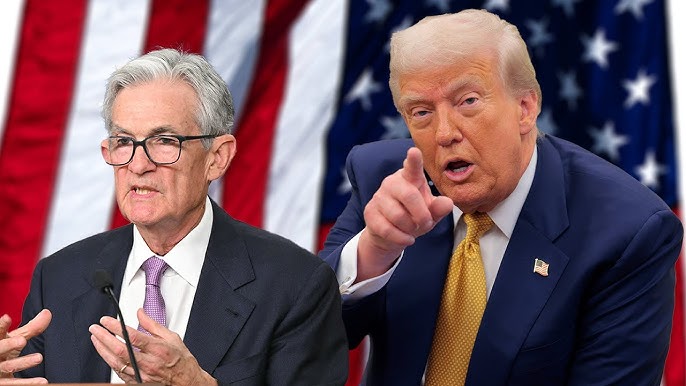
Complicating matters is ongoing political pressure. President Donald Trump has repeatedly criticised Powell and the Fed, demanding sharper and more aggressive rate cuts. Powell avoided direct reference to these attacks but emphasised the independence of the central bank.
“FOMC members will make these decisions, based solely on their assessment of the data and its implications for the economic outlook and the balance of risks. We will never deviate from that approach,” Powell said, underscoring the Fed’s determination to remain insulated from political influence.
Tariffs and Inflation Uncertainty
One of the thorniest challenges facing the Fed is gauging the long-term impact of tariffs on inflation. The Trump administration argues that the effect will be temporary and limited, justifying lower rates to support growth. Powell, however, struck a more cautious note, acknowledging that while the “reasonable base case” is for tariff effects to be short-lived, uncertainties remain high.
He explained that tariffs take time to filter through supply chains and distribution networks, and with tariff rates continuing to evolve, the adjustment process could be prolonged. This complicates the Fed’s inflation outlook, leaving policymakers wary of acting too quickly.
Recent data shows consumer prices edging higher while wholesale costs rise more steeply, adding to the ambiguity. For Powell, this underlines the need for patience and a careful weighing of policy options.
Lessons From the Past and Policy Framework
Beyond the immediate outlook, Powell also reflected on the Fed’s five-year policy framework review, which examined the central bank’s approach since the Covid-19 pandemic.
In 2020, the Fed adopted a flexible average inflation targeting (FAIT) strategy, allowing inflation to run moderately above the 2% target for some time after periods of underperformance. The goal was to ensure a stronger labour market recovery.
However, this approach quickly ran into trouble. Inflation surged to 40-year highs soon after, far surpassing the Fed’s expectations. At the time, policymakers dismissed the rise as “transitory,” delaying necessary action. Powell acknowledged these missteps candidly, saying:
“As it turned out, the idea of an intentional, moderate inflation overshoot had proved irrelevant. There was nothing intentional or moderate about the inflation that arrived a few months after we announced our 2020 changes.”
The episode has left lasting scars, reinforcing the hardship that high inflation imposes, particularly on vulnerable households. The Fed has since recommitted to its 2% inflation target, despite debates about whether it should be adjusted.
What Lies Ahead
Looking forward, Powell made clear that the Fed’s priority remains balancing its dual mandate of price stability and maximum employment. With policy already in restrictive territory, further decisions will hinge on incoming data and how risks evolve.
For investors, the key question is timing. The FOMC’s September 16-17 meeting looms large, with markets betting heavily on the first rate cut of this cycle. But Powell’s careful phrasing suggests that while a cut is on the table, it is not guaranteed.
The Fed faces a delicate task: cut too soon, and inflation could re-ignite; wait too long, and the economy risks slowing more sharply. For now, Powell’s message is one of cautious flexibility, with the Fed ready to adapt as the outlook becomes clearer.
Powell’s Jackson Hole speech was less about bold announcements and more about managing expectations. His message balanced reassurance with caution: the Fed is open to rate cuts but is determined to avoid repeating past mistakes of moving too hastily or dismissing risks.
Leave a Reply