
In the world of digital transformation, few technologies have generated as much excitement, debate, and curiosity as blockchain. What began as the foundation for cryptocurrencies like Bitcoin has now evolved into a vast ecosystem that supports everything from supply chain tracking to digital identity and financial services. At the heart of this technological revolution lies a fundamental divide, the distinction between public and private blockchains.
Although they share the same foundational concept of distributed ledger technology, public and private blockchains differ in structure, purpose, and governance. Understanding these differences is essential for businesses, developers, and governments aiming to harness blockchain’s full potential.
The Foundation of Blockchain Technology
To understand the split between private and public blockchains, it’s important to first grasp what blockchain really is. A blockchain is a distributed database that records transactions across multiple computers, making it nearly impossible to alter or delete information retroactively. Every transaction is grouped into a “block,” and each block is linked to the one before it, creating an unbreakable chain of records.
This design ensures transparency and security, as every participant in the network can verify the data. However, not all blockchains are open to everyone. The way participants are granted access defines whether a blockchain is public or private.
Public Blockchains: The Power of Open Participation
A public blockchain is open to anyone. Anyone can join, read, write, or participate in the network without needing special permission. Bitcoin and Ethereum are the most famous examples.
Public blockchains are the embodiment of decentralization. They operate without a central authority, relying instead on consensus mechanisms like Proof of Work (PoW) or Proof of Stake (PoS) to validate transactions. Every participant has a copy of the ledger, ensuring transparency and trust without intermediaries.
This openness makes public blockchains ideal for use cases that depend on trustless environments. Cryptocurrencies, decentralized finance (DeFi) platforms, and non-fungible token (NFT) marketplaces thrive on these networks because users do not have to rely on any central organization.
However, this inclusivity also comes with trade-offs. Public blockchains often struggle with scalability. Since every transaction must be verified by thousands of nodes, the process can be slow and resource-intensive. Network congestion and high transaction fees are common challenges, especially on networks like Ethereum during peak activity.
Security, on the other hand, is one of the strongest advantages of public blockchains. The sheer number of participants makes it nearly impossible for a single entity to manipulate the network. Attacking a public blockchain would require immense computing power, making such attempts economically unfeasible.
Private Blockchains: Control, Speed, and Confidentiality
Unlike their public counterparts, private blockchains are permissioned systems. Participation is restricted to specific users who are granted access by a central authority or governing consortium. Hyperledger Fabric, Corda, and Quorum are well-known examples.
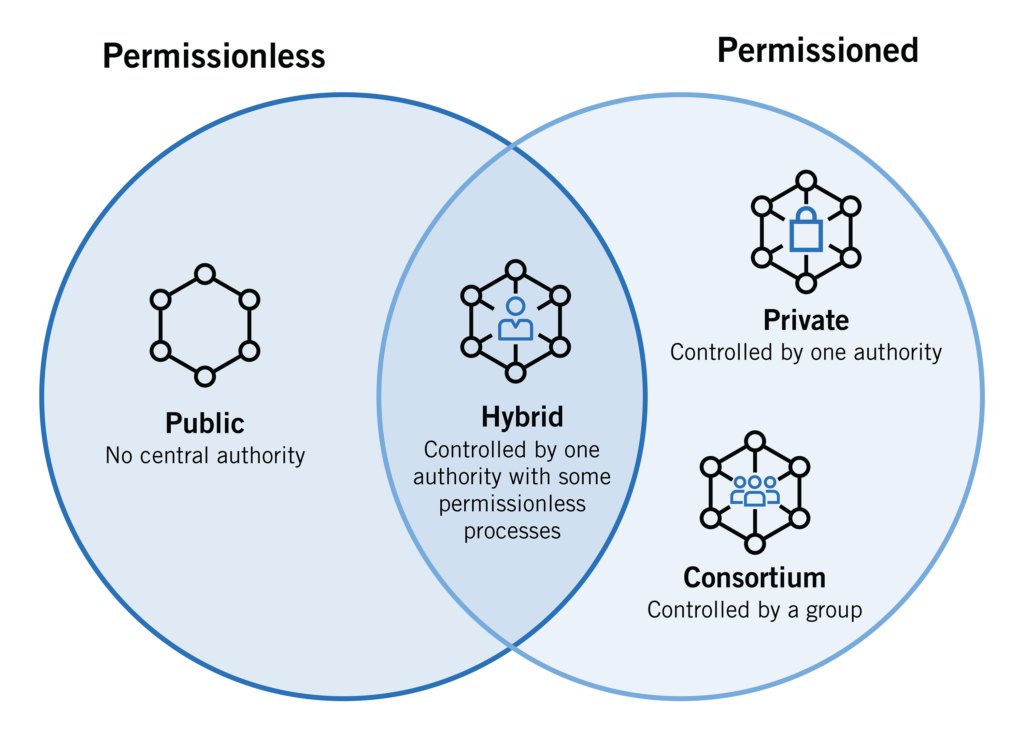
Private blockchains prioritize control and efficiency over decentralization. They are commonly used by enterprises, banks, and government agencies that require high transaction speeds, privacy, and compliance with regulations.
In these systems, the central administrator decides who can read or write data, validate transactions, or join the network. Because fewer participants are involved, private blockchains can achieve much faster transaction times compared to public ones.
For instance, a consortium of banks using a private blockchain can settle interbank transfers in seconds instead of hours, without revealing sensitive details to the public. Similarly, logistics companies can use private blockchains to track shipments internally, ensuring transparency across partners without exposing data to competitors.
However, this level of control introduces certain limitations. The centralized nature of private blockchains means they are not truly decentralized, and their security depends heavily on the integrity of the controlling organization. If the central authority is compromised, the entire system’s trust can be undermined.
Comparing Public and Private Blockchains
While both types of blockchain share common technology, their applications and characteristics differ significantly.
1. Access and Participation
Public blockchains are open networks. Anyone can participate, validate, and contribute. Private blockchains restrict participation to approved members, ensuring controlled access.
2. Transparency and Privacy
In public blockchains, all transactions are visible to everyone on the network, ensuring maximum transparency. Private blockchains, in contrast, offer privacy by limiting visibility to authorized participants.
3. Speed and Scalability
Because public blockchains involve thousands of nodes verifying each transaction, they are slower and less efficient. Private blockchains, with fewer participants, can process transactions much faster.
4. Security and Trust
Public blockchains derive security from decentralization and the vast number of participants. Private blockchains rely on trust in a central authority or consortium, making them more vulnerable to insider threats.
5. Governance and Maintenance
In public blockchains, governance is typically managed through community consensus. Changes require broad agreement from network participants. In private blockchains, governance is centralized and decisions can be made quickly by administrators.
Real-World Use Cases
Public blockchains are best suited for open, decentralized systems. Bitcoin uses a public blockchain to allow global peer-to-peer financial transactions without intermediaries. Ethereum powers decentralized applications and smart contracts accessible to anyone with an internet connection.
Private blockchains, on the other hand, are making significant impacts in the enterprise world. For example, IBM’s Hyperledger Fabric helps corporations manage supply chains with traceability and trust. Financial institutions use Corda to streamline transactions and reduce reconciliation costs. Governments are exploring private blockchains for secure identity management and data sharing.
A hybrid approach is also emerging. Some organizations combine public transparency with private efficiency, creating consortium blockchains that balance openness and control. These are particularly popular in industries that require collaboration among multiple organizations, such as trade finance, energy management, and healthcare.
The Future of Blockchain: Collaboration over Competition
As blockchain technology continues to evolve, the line between public and private blockchains is blurring. Public blockchains are exploring ways to improve scalability through innovations like layer-two solutions and sharding. Private blockchains are adopting more decentralized governance models to build trust among participants.
The future may lie in interoperability, the ability for different blockchains to communicate and share data seamlessly. Projects like Polkadot, Cosmos, and Chainlink are already building bridges between public and private networks, enabling a more interconnected blockchain ecosystem.
In the coming years, businesses and governments will increasingly rely on blockchain not just as a tool for record-keeping but as a framework for digital trust. Public blockchains will continue to drive open innovation and financial inclusion, while private blockchains will power secure, enterprise-grade solutions.
Conclusion
The debate between private and public blockchains is not about which is better, but rather which is more suitable for a given purpose. Public blockchains champion transparency, openness, and decentralization, making them ideal for global systems that value trustless collaboration. Private blockchains, on the other hand, prioritize efficiency, privacy, and regulatory compliance, key requirements for enterprise operations.
As blockchain adoption grows, these two models will likely coexist, each addressing different needs within the digital landscape. The technology’s true potential will be realized not through competition between public and private systems, but through their ability to complement each other.
Blockchain is no longer a futuristic concept; it’s a practical solution shaping industries and redefining trust in the digital era. Whether public or private, its impact on how we store, share, and secure information is only beginning to unfold.
Leave a Reply