S&P Global Ratings has given Sky Protocol, formerly known as Maker Protocol, a “B-” issuer credit rating, the first time a major credit rating agency has formally assessed a decentralised finance (DeFi) project. The move signals growing overlap between crypto and traditional finance, as rating agencies begin to evaluate blockchain-based systems by the same standards as conventional institutions.
First-Ever DeFi Credit Rating
Sky Protocol operates as a decentralised lending platform, allowing users to borrow cryptocurrency-backed loans. Its USDS stablecoin, used for transactions and lending, is currently the fourth-largest stablecoin by market value at around $5.36 billion, according to CoinMarketCap.
S&P Global’s rating focuses on Sky Protocol’s ability to meet its financial obligations and the stability of its assets, particularly its stablecoins USDS and DAI, along with their interest-bearing versions, sUSDS and sDAI.
Sky’s USDS stablecoin received a stability score of 4 on S&P’s scale, which runs from 1 (“very strong”) to 5 (“weak”). A score of 4 means its ability to maintain a stable value is “constrained” and could face stress under adverse conditions.
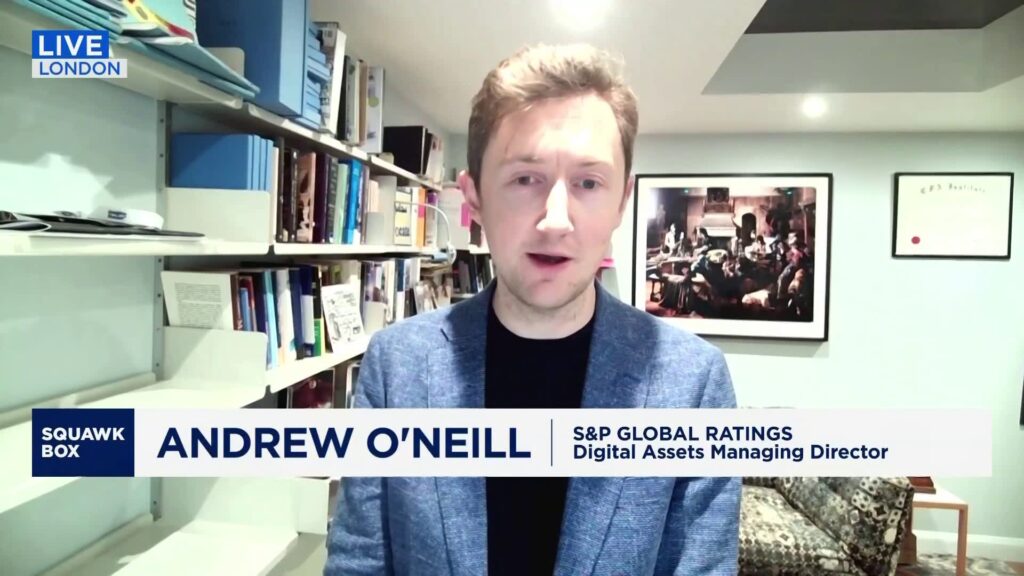
Andrew O’Neil, S&P’s lead analyst for digital assets, explained:
“A ‘B-’ rating means that we believe the protocol currently can meet its financial obligations, but it would be vulnerable in adverse business, financial and economic conditions.”
Key Concerns: Governance, Capital and Regulation
S&P’s assessment identified several risks that could undermine Sky Protocol’s stability:
- High Depositor Concentration: A large share of deposits is held by relatively few participants, making the system more exposed to large withdrawals.

- Centralised Governance: Despite being a DeFi protocol, voting power is concentrated. Sky co-founder Rune Christensen holds nearly 9% of governance tokens, and S&P noted low voter turnout during important decisions.
- Reliance on the Founder: Decision-making influence and dependency on Christensen’s leadership create operational risk.
- Regulatory Uncertainty: Global rules for DeFi remain unclear, increasing the chance of sudden legal or compliance challenges.
- Weak Capitalisation: With a risk-adjusted capital ratio of just 0.4% as of 27 July, Sky has a limited reserve buffer to absorb credit losses.
The rating also warns of potential stress points, such as mass withdrawals that could exceed liquidity reserves, or credit losses that surpass available capital.
Despite these vulnerabilities, S&P acknowledged that Sky Protocol has recorded minimal credit losses and consistent earnings since 2020.
Understanding the Stablecoin Assessment
S&P Global began its stablecoin stability assessments in December 2023 to measure how well different issuers can maintain their tokens’ peg to traditional currencies.
The assessment compares DeFi stablecoins with centralised stablecoins issued by companies like Circle and Tether.
- Circle’s USDC: Rated 2 (“strong”)
- Tether (USDT): Rated 4 (“constrained”) due to transparency issues
- Sky Protocol’s USDS: Also rated 4, mainly due to its complex asset base and weak capital reserves.
O’Neil said:
“Tether’s weaknesses are more around transparency, whereas USDS has a more complex asset base compared to USDC. And indeed, the relatively weak capital position is also something that drives that relative ranking.”
For Sky, the protocol’s “anchor rating” was set at “bb,” which is four notches below the “bbb+” rating typically given to US banks. The main factor behind this lower score was regulatory uncertainty within the DeFi sector.
Traditional Finance Meets DeFi
Sky Protocol’s rating is part of a broader push by traditional financial institutions to assess blockchain-based projects using familiar credit models. This approach aims to bring greater transparency to the crypto sector and help institutional investors better understand the risks.
The move follows S&P’s earlier work rating blockchain-linked financial products. In June 2024, Figure Technology Solutions, a platform offering blockchain-based mortgage securitisation, secured an “AAA” rating for its $355 million mortgage asset deal. This marked the first blockchain-based securitisation to earn such a high rating.
For Sky Protocol, the process of being rated also provided an opportunity to review its own operations. The Sky Ecosystem Asset-Liability Committee stated that the exercise helped them evaluate both traditional counterparty risks and DeFi-specific threats like:
- Smart contract vulnerabilities
- Oracle and data feed risks
- Blockchain bridge security issues
- Governance weaknesses
They also challenged some of the analytical assumptions that apply to traditional finance but may not fully match the on-chain environment.
What This Means for DeFi
This rating sets an important precedent. While a “B-” is far from a strong rating, it signals that DeFi projects are increasingly being held to traditional credit standards. That could make it easier for institutional investors to weigh the risks and benefits of participating in DeFi ecosystems.
However, it also highlights a major challenge: many DeFi protocols, even well-known ones like Sky (formerly Maker) face significant issues with governance centralisation, small capital reserves and unclear regulations.
If more DeFi protocols seek similar assessments, they may need to address these weaknesses to earn stronger ratings and attract mainstream financial backing.
For now, Sky Protocol’s “B-” rating will likely serve as both a milestone and a cautionary signal for the entire sector.
Leave a Reply