Circle has revealed that Asia-Pacific has become the fastest-growing hub for stablecoin activity, with $2.4 trillion in on-chain transactions recorded between June 2024 and June 2025. The figure cements the region’s growing influence in digital finance and places Singapore and Hong Kong among the world’s leading stablecoin centres, behind only the United States.
Asia-Pacific Emerges as a Global Stablecoin Powerhouse
At the Circle Forum in Singapore, Yam Ki Chan, Circle’s Vice President for Asia-Pacific, announced the landmark $2.4 trillion in activity, describing the region as unmatched in its interest in digital assets. The Singapore-China corridor has now overtaken others as the busiest route for cross-border stablecoin transactions, highlighting the city-state’s pivotal role in the movement of digital money.
Circle itself has been quick to build a presence in the region. The company opened its Singapore office in May 2025, signalling its commitment to expanding across Asia-Pacific. The launch, attended by Sopnendu Mohanty, Chief FinTech Officer of the Monetary Authority of Singapore (MAS), reinforced the regulatory and commercial importance of Singapore within the digital finance ecosystem.
Soaring Transaction Volumes and Corporate Adoption
The surge in stablecoin activity has been accompanied by rapid growth in corporate use. Monthly stablecoin transaction volumes have climbed from under $100 million in early 2023 to more than $3 billion by early 2025. This acceleration reflects businesses increasingly adopting stablecoins for efficiency and cost-effectiveness.
Sectors as diverse as travel, hospitality and luxury retail are beginning to rely on stablecoin payments. Notable adopters include Singapore’s Wetrip travel agency, Capella Hotels and luxury reseller Ginza Xiaoma, known for dealing in exclusive Birkin handbags. For many businesses, stablecoins provide an attractive alternative to traditional settlement channels, reducing transaction times and fees while offering cross-border flexibility.
Regulation Shapes the Market’s Future
Alongside adoption, regulatory developments are proving critical to shaping the market. Hong Kong took a significant step in August 2025 by introducing a dedicated regulatory framework for stablecoins. In the US, the passage of the GENIUS Act in June provided a legal foundation for issuance and oversight, aiming to balance innovation with consumer protection.
China, though cautious on cryptocurrency use, may also be reconsidering its stance. In July 2025, Shanghai’s government formed a task force to explore blockchain’s role in global trade, signalling a potential policy shift. These moves suggest that even traditionally restrictive jurisdictions are beginning to acknowledge the importance of blockchain-enabled financial flows.
Industry-wide data points to the scale of momentum. By May 2025, global circulating stablecoin supply averaged $225 billion, up 63% year-on-year, with monthly transaction volumes hitting $625 billion. Such growth demonstrates not only adoption within Asia-Pacific but also a worldwide integration of stablecoins into mainstream commerce.
Circle’s Strategy and Asia’s Central Role
For Circle, Asia-Pacific is more than just a high-growth market, it is a proving ground for the future of on-chain finance. The firm’s expansion in Singapore underscores the city-state’s position as both a regulatory safe haven and a commercial hub for digital assets.
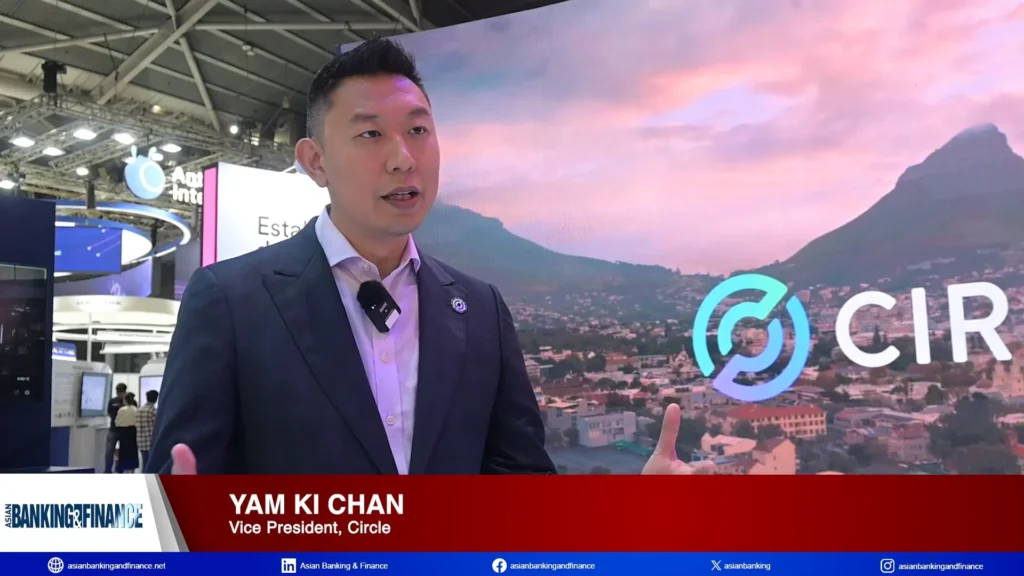
“Asia-Pacific’s interest in on-chain finance is unmatched globally and is unlikely to slow,” said Yam Ki Chan. His comments highlight Circle’s belief that the region will play a decisive role in shaping how stablecoins and digital assets are adopted worldwide.
The combination of rising transaction volumes, deepening institutional participation and regulatory clarity positions Asia-Pacific as a bellwether for digital finance. With Singapore and Hong Kong solidifying their global ranking, the region’s influence is set to expand further, reshaping cross-border commerce and the role of money itself.
Leave a Reply