
Starknet, an Ethereum layer 2 network built on zero knowledge rollup technology, has suffered another bout of mainnet downtime, raising renewed questions about the network’s reliability after a series of disruptions last year. The latest incident comes just as the ecosystem steps into 2026, with developers confirming that core services were temporarily unavailable.
Network Disruption Reported on X
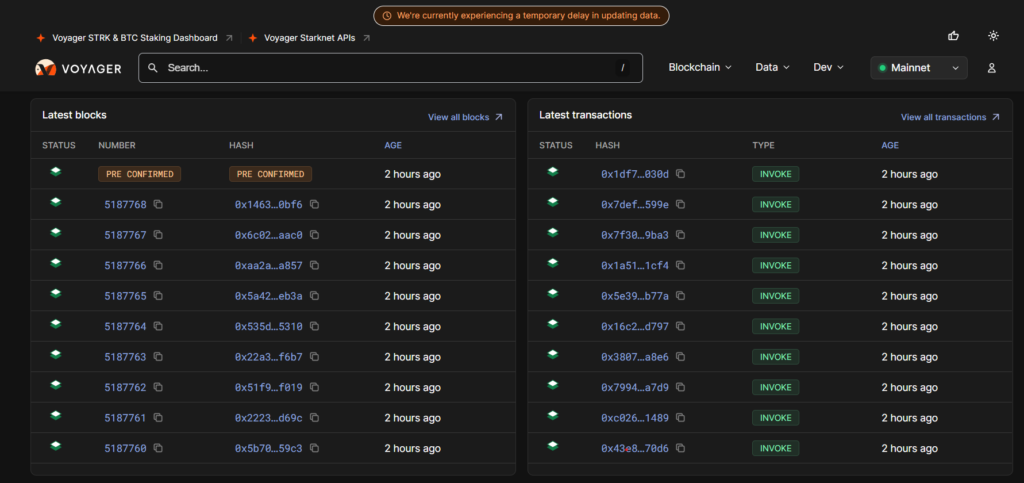
The Starknet team acknowledged the issue in a post on X, stating that the network was experiencing downtime and that engineers were actively investigating the cause. The team said efforts were underway to restore full functionality as quickly as possible, but stopped short of sharing technical details behind the failure.
At the time the update was posted, Starknet had been down for a little over two hours. Users reported stalled transactions and an inability to interact with applications built on the network, particularly in decentralized finance and gaming, two of Starknet’s key use cases.
What Starknet Does and Why It Matters
Starknet operates as a zero knowledge rollup based layer 2 on Ethereum. It processes transactions offchain and then submits cryptographic proofs to Ethereum, allowing it to scale activity while relying on Ethereum’s base layer for security. The design is intended to offer faster transaction speeds and lower fees compared with executing everything directly on Ethereum mainnet.
Beyond Ethereum native applications, Starknet has also positioned itself as a potential bridge for Bitcoin related financial use cases. The project has spoken publicly about a Bitcoin DeFi or BTCFi strategy, promoting the network as infrastructure that could help connect Bitcoin based financial activity with Ethereum smart contracts.
Despite the outage, the STRK token showed little immediate reaction and was trading largely flat at the time of writing, suggesting limited short term market panic.
Another Outage Adds to a Troubling Pattern
This is not the first time Starknet’s mainnet has gone offline. Throughout 2025, the network experienced several incidents that drew attention from developers and users alike. External monitoring services recorded multiple periods of slow block production or complete halts in transaction processing during the year.
One of the most serious incidents occurred in September 2025 following the rollout of a major upgrade known as Grinta version 0.14.0. That update triggered an extended disruption in which block production stopped entirely. The network also experienced two chain reorganizations, rolling back close to an hour of activity and forcing users to resubmit transactions.
Earlier in the year, Starknet faced another multi hour outage that was linked to sequencer related problems, further highlighting operational risks around one of the most critical components of layer 2 infrastructure.
Lessons From the 2025 Grinta Incident
After the September disruption, Starknet published a detailed incident report outlining what went wrong. According to the report, the Grinta related downtime lasted around nine hours. The root causes included failures in Ethereum RPC providers and bugs that affected how the sequencer behaved under certain conditions.
The team said those issues exposed weaknesses in both architecture and monitoring. In response, Starknet committed to making architectural changes, improving redundancy and expanding its monitoring systems to detect problems earlier and respond faster.
Whether the latest downtime is connected to those previously identified weaknesses remains unclear. The team has not yet released a postmortem or technical explanation for the current incident.
Team Response and Next Steps
A Starknet representative confirmed that engineers were working to repair the issue and bring the network back online. Users and developers are now waiting for further updates, including confirmation of whether any transactions were reverted or if funds were affected.
As Starknet continues to compete with other Ethereum layer 2 networks, repeated downtime risks undermining confidence among developers building long term applications. The coming days may prove important, not just for restoring service, but for reassuring the ecosystem that lessons from past outages are being fully applied.
Leave a Reply