South Korea may soon join the growing list of countries embracing cryptocurrency-based financial products, as the nation’s top presidential hopefuls have expressed support for legalising spot Bitcoin exchange-traded funds (ETFs). While the pledges have sparked optimism among investors and the crypto community, industry experts remain cautious, citing past delays and unmet promises.
Presidential Hopefuls Signal Pro-Crypto Stance
The three leading presidential candidates have voiced support for Bitcoin ETFs and institutional cryptocurrency investments, marking a potential policy shift in one of Asia’s most technologically advanced economies.
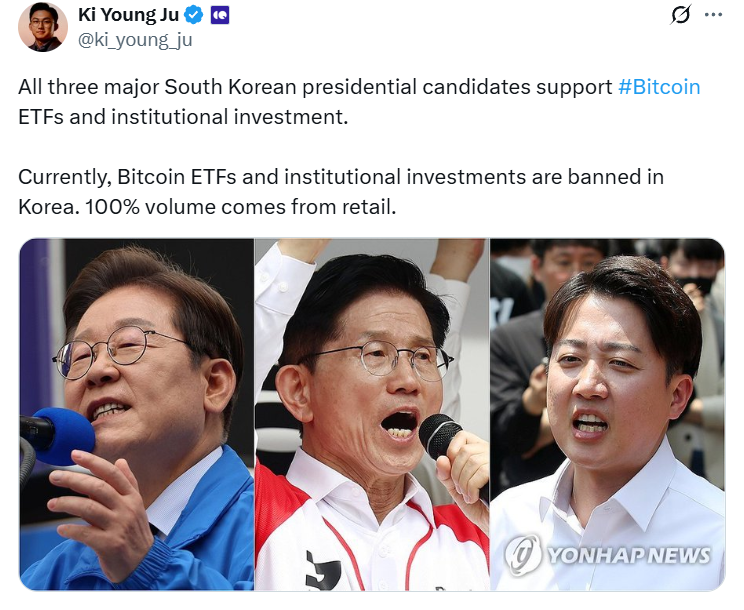
“All three major South Korean presidential candidates support Bitcoin ETFs and institutional investment,” said Ki Young Ju, founder and CEO of on-chain data platform CryptoQuant, in a post on X (formerly Twitter) on May 14.
Despite growing public interest in crypto, South Korea currently bans Bitcoin ETFs and institutional crypto investment. Ju noted that due to the regulatory restrictions, “100% of the volume comes from retail.”
Lee Jae-myung Promises ETF Legalisation
Democratic Party leader Lee Jae-myung recently reaffirmed his commitment to legalising spot crypto ETFs. On May 6, he pledged to reduce transaction fees and “create a safe investment environment so that young people can build assets and plan for the future,” according to a report from The Korean Economic Daily.
The Democratic Party had made similar promises in its 2024 campaign manifesto, including plans to legalise Bitcoin ETFs. However, the actual progress has been minimal, leading to public scepticism about whether these proposals will be implemented.
Scepticism Remains Despite Political Support
Despite the encouraging statements from political leaders, regulation experts and market analysts are not fully convinced that change is imminent.
“While the candidates’ pro-crypto pledges to push to legalise spot Bitcoin ETFs and reduce fees signal a potential shift, history tempers optimism,” said Anndy Lian, author and intergovernmental blockchain adviser.
He added that although South Korea might align itself with other progressive markets such as Hong Kong, “the performance of ETFs will depend on various other factors,” including market readiness, regulatory execution, and investor education.
Regulatory History Raises Concerns
Sceptics point to previous political promises that failed to materialise. The conservative People Power Party, elected in 2022, had also pledged to lift the ban on crypto ETFs and revise the one-exchange-one-bank rule. However, little was accomplished before President Yoon Suk-yeol was impeached.
While the Financial Services Commission (FSC) has shown signs of regulatory openness towards crypto, tangible reforms have been slow to progress.
Hong Kong’s ETF Launch Offers Cautionary Tale
South Korean policymakers are closely watching developments in Hong Kong, which recently launched its first batch of Bitcoin and Ether-based ETFs on April 30, 2024. Despite the fanfare, the debut saw underwhelming trading activity, especially when compared to the strong inflows recorded by their U.S. counterparts.
Still, a pro-crypto president in South Korea could signal a shift in the country’s approach, potentially aligning it with global trends and boosting its financial competitiveness. If realised, this could open the door to institutional investments in digital assets and broaden market participation beyond retail traders.
Leave a Reply