
A landmark ruling by the US Fifth Circuit Court of Appeals has nullified the sanctions imposed by the Treasury Department on Tornado Cash, a decentralized crypto-mixing platform. The decision, celebrated by privacy advocates and the crypto community, raises critical questions about regulating blockchain tools in the context of criminal activities.
Sanctions Deemed Overreach
Tornado Cash was sanctioned by the Treasury’s Office of Foreign Assets Control (OFAC) in 2022, accused of enabling illicit transactions, including laundering funds for North Korea’s Lazarus Group. However, the court ruled that the immutable smart contracts powering Tornado Cash cannot be considered “property” under the International Emergency Economic Powers Act (IEEPA).
“These contracts, being autonomous and unalterable, cannot be owned, controlled, or restricted,” the court stated.
Impact on Decentralized Tools
The court’s decision underscores the decentralized nature of Tornado Cash, noting that while specific individuals might be barred from using the platform, its underlying technology remains accessible globally. Coinbase’s Chief Legal Officer Paul Grewal hailed the verdict, calling it a “historic win for crypto and liberty.”
Grewal stressed the importance of distinguishing between tools and misuse, criticising the government’s blanket ban on open-source technology.
TORN Token Surges
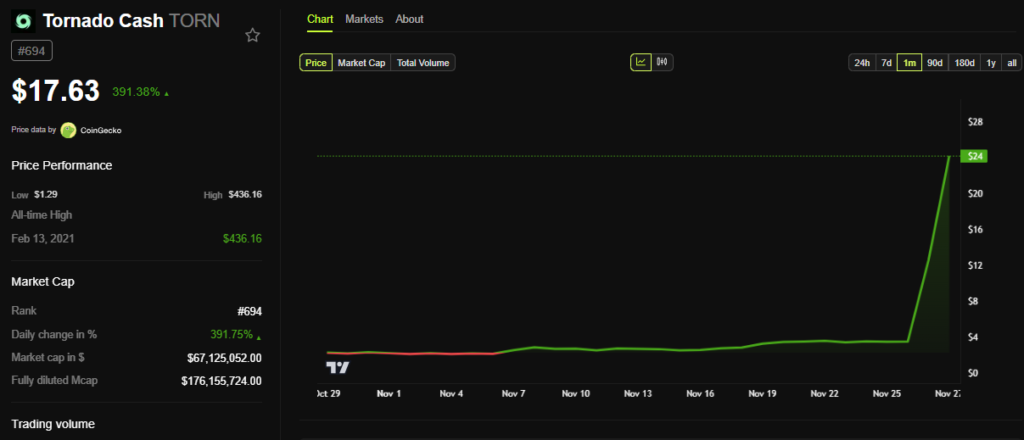
Following the ruling, Tornado Cash’s native token, TORN, experienced a meteoric rise of nearly 400%, trading at $17.63. This surge reflects renewed investor confidence in the platform’s potential to re-establish itself as a key player in decentralized finance (DeFi).
Despite the ruling, Tornado Cash is not free from legal scrutiny. The court’s decision applies only to smart contracts without administrative keys, leaving other aspects of the platform vulnerable to sanctions. Its founders still face allegations of facilitating money laundering.
The case highlights the ongoing struggle to adapt traditional legal frameworks to decentralized technologies. Critics warn that the ruling might embolden bad actors, while privacy advocates argue that targeting tools undermines the principles of decentralization.
As lawmakers continue to debate the regulation of crypto-mixing services, the ruling is a pivotal moment for the DeFi landscape, with implications that extend far beyond Tornado Cash.
Leave a Reply