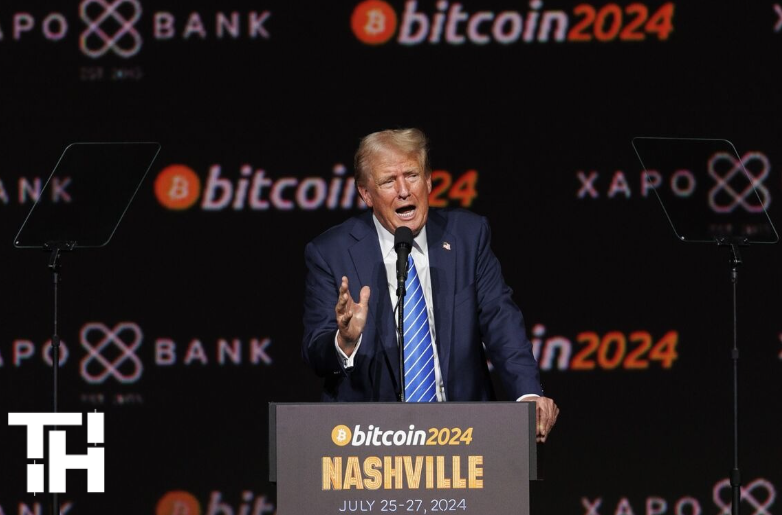
US President Donald Trump has signed an executive order prohibiting the creation and use of central bank digital currencies (CBDCs) in the United States. The decision, announced on 23 January, is expected to reshape the landscape of cryptocurrency regulation and adoption in the country, positioning the private crypto market as a key player in the financial ecosystem.
CBDC Ban Aims to Protect Financial Stability and Privacy
The executive order prohibits the establishment, issuance, and circulation of CBDCs, citing concerns over their potential to destabilise the financial system, infringe on individual privacy, and undermine national sovereignty. This decision marks a significant shift in the government’s stance towards digital currencies, prioritising private sector solutions over state-controlled digital assets.
Boost for Institutional Crypto Adoption
The move is being hailed as a “game-changer” for the US crypto industry by industry experts. Anndy Lian, a blockchain adviser and author, believes the order signals a more structured and transparent regulatory environment for cryptocurrency.
“This isn’t just about setting rules; it’s about laying the groundwork for crypto to play a larger, more legitimate role in the economy,” Lian commented. He added that the clarity offered by this directive could encourage institutional investors to enter the crypto market, potentially driving adoption and growth.
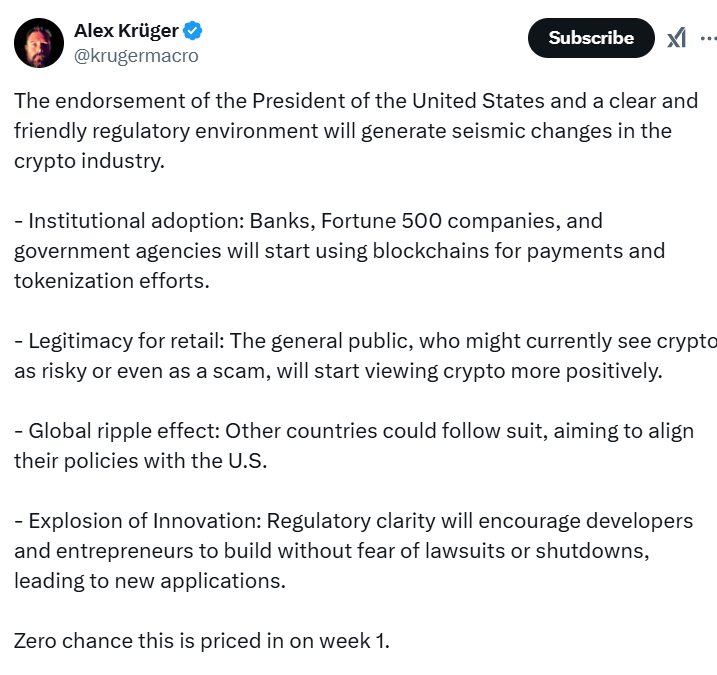
Economist Alex Krüger echoed these sentiments, suggesting that the ban could catalyse blockchain adoption for payments and asset tokenisation among major financial institutions.
CBDC Criticism Sparks Debate
CBDCs have often been promoted as tools for enhancing financial inclusion. However, critics argue they pose risks related to surveillance and governmental overreach. Such concerns were amplified in 2023 when Brazil’s central bank published the source code for its CBDC pilot, which revealed embedded mechanisms for freezing or reducing user funds within wallets.
Globally, over 140 countries are reportedly working on CBDC pilots, with China’s digital yuan project among the most advanced. Trump’s decision to ban CBDCs positions the US on a divergent path, focusing instead on existing cryptocurrencies like Bitcoin and Ethereum.
Confidence in the Private Crypto Market
The executive order reflects Trump’s confidence in the private cryptocurrency market over government-backed digital dollars. Lian sees this as a strategic move, describing it as a “vote of confidence” in established cryptocurrencies, potentially boosting their legitimacy and market value.
“This move tells you where Trump stands: He’s betting on the existing crypto market rather than creating government-backed digital dollars,” Lian said.
Exclusion of Federal Agencies from Crypto Oversight
In another notable development, the executive order excludes the Federal Reserve and the Federal Deposit Insurance Corporation (FDIC) from participating in cryptocurrency working groups.
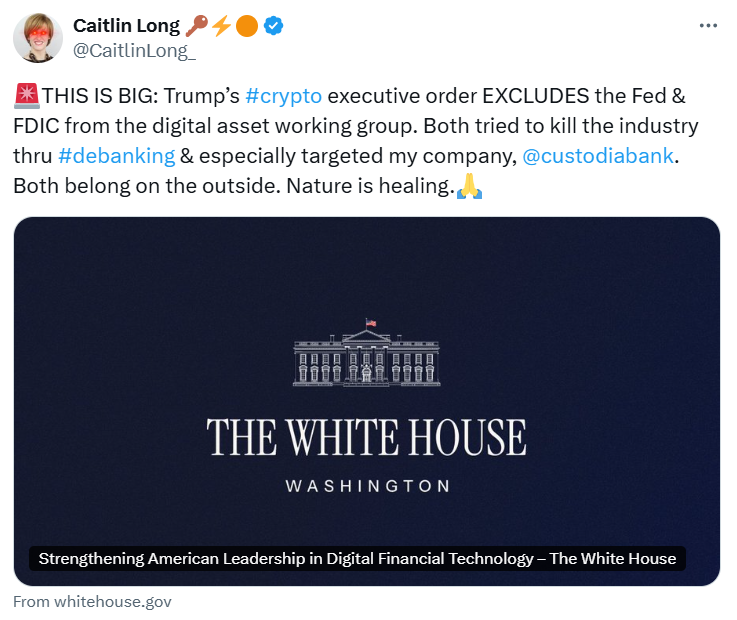
Caitlin Long, CEO of Custodia Bank, welcomed this exclusion, highlighting the previous efforts by these institutions to undermine the crypto industry. “Both tried to kill the industry through debanking, especially targeting my company,” Long stated in a post on X (formerly Twitter).
A Turning Point for Crypto Regulation
The executive order marks a bold shift in the US’s approach to digital currencies. By rejecting CBDCs and embracing the private crypto market, the Trump administration signals its intent to foster innovation while addressing concerns over privacy and governmental control.
With institutional interest in cryptocurrencies poised to grow under a clearer regulatory framework, the industry may witness a new era of mainstream adoption.
Leave a Reply