The global digital economy is entering a new era, one where money moves as freely as information. Coinbase, one of the world’s leading cryptocurrency firms, has unveiled x402, an open internet payment standard that embeds stablecoin transactions directly into web interactions. The initiative represents a major technological milestone: transforming the long-dormant HTTP “402 Payment Required” status code into a real-world payment mechanism for the age of AI and autonomous software.
For decades, the web has relied on outdated financial rails, credit cards, bank transfers and subscriptions, that were never designed for a global, programmable internet. These systems are slow, expensive and regionally fragmented. As software automation and AI continue to evolve, the limitations of legacy payment models have become more evident than ever. Coinbase’s x402 aims to solve that problem, bridging the gap between digital information exchange and digital value exchange.
Who’s Backing x402 and Where It Lives
One of the major backers of x402 is Coinbase and in collaboration with Cloudflare. Together, they are positioning x402 as an open-standard payment layer. The protocol is governed by what’s being called the x402 Foundation, a body co-founded by Coinbase and Cloudflare.
In terms of infrastructure, a lot of x402 activity is happening on Base, Coinbase’s Ethereum-L2 roll-up. However, the protocol is designed to be cross-chain and you’ll see implementations or ambitions on chains such as Solana, Polygon, NEAR, etc.
Why this matters: if AI agents need to pay for things in the real world, compute, APIs, data storage, services, then having a low-friction payments rail matters. Stablecoins like USDC (especially via Circle) feature heavily in that stack.
How x402 Works: Key Features & Mechanics
Here’s how the protocol delivers on autonomous agent-based payments:
- Embedded in HTTP / Web-Native Interactions
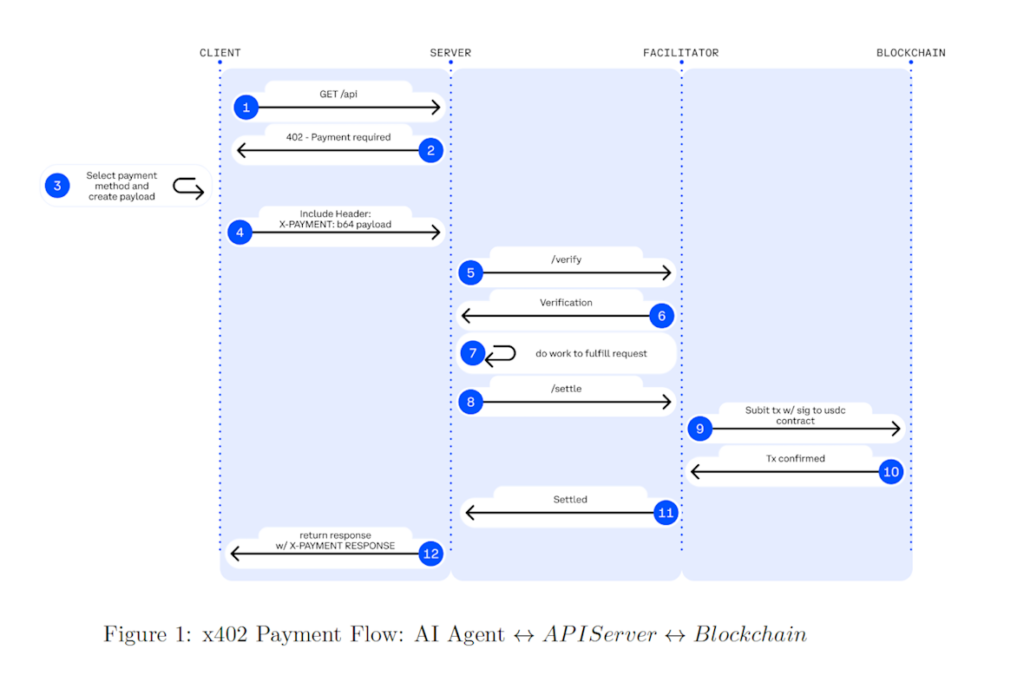
One of the distinguishing features of x402 is that it embeds payments directly into HTTP interactions. It borrows inspiration from something called the “402 Payment Required” status code, hence the name. In practice this means when an agent triggers an HTTP request for some API, that API may require payment as part of the request-response cycle. - Micro-Payments & Fast Settlement
x402 supports very fine-grained payments, potentially down to as little as $0.001 (one-tenth of a cent) per request, with settlement times on the order of a couple of seconds. That enables high-volume, low-value payments at scale, which is essential if agents are autonomously making thousands or millions of tiny requests.
- Stablecoin Friendly & On-Chain Finality
Since many of the payments go via stablecoins like USDC, the protocol is inherently built to work with crypto rails. It leverages existing EVM (Ethereum Virtual Machine) token-standards rather than reinventing them. For instance, some transfers may use features in USDC that conform to EIP-3009 (which allows more flexible programmable transfers). - Agentic Autonomy
Agents using x402 can transact without human intervention. They can discover services (via a linked Model Context Protocol), evaluate costs and pay automatically using their own on-chain wallet or credentialed identity. That is what enables the so-called agentic economy, where software agents are not just tools but stakeholders and spenders. - Cross-Chain Capacity
Although Base (Coinbase’s L2) is presently central, x402 is conceived to function beyond any one chain. As AI-agent usage proliferates, agents may need to access services on different blockchains, so cross-chain interoperability is crucial.
Use Cases & Ecosystem Players
x402 isn’t just abstract architecture: it’s already shaping protocols and tokens. Some of the key entities and their roles:
- PingObserver, reportedly the first token minted by x402.
- Virtuals Protocol, an ecosystem agent provider that leverages x402. It has tokens such as $DREAM, $SANTA, $GLORIA, $AURA associated with it.
- Heurist AI, Questflow, AnchorBrowser, other protocols or agents building around x402.
- GoKiteAI, which recently announced a collaboration with Brevis Network to enable privacy-preserving payments via agents. This too uses x402 as the underlying payments layer.
- PayAI Network, another protocol aligned with agentic payments via x402.
- On the infrastructure side, Cloudflare Agents SDK is a partner in the ecosystem. Also, Google’s Agent-to-Agent (A2A) payments protocol is mentioned in relation to x402, hinting at potential hybrid human-agent payment flows.
These players are experimenting with how autonomous agents can initiate payments when, for example, they consume compute, access APIs, or retrieve data.
Beyond protocol builders, neo-banks and stablecoin issuers are beginning to orient toward this space:
- Circle (issuer of USDC) has ongoing relationships with Coinbase and is likely to be a key payments corridor for agentic transactions.
- Tether (via its wallet development kit) is also gearing for a future with millions (or trillions) of wallets, many of which aren’t humans.
- Tria, which recently partnered with Billions for zk-KYC (privacy for identity) in agent payment contexts.
- Traditional payments networks like Visa and Mastercard are also exploring AI-Agent programs; even though they’re not directly x402, these moves signal that the whole payments industry expects AI-agent-powered economic activity.
Why It Matters And What to Watch
1. Agentic Economy Is Coming
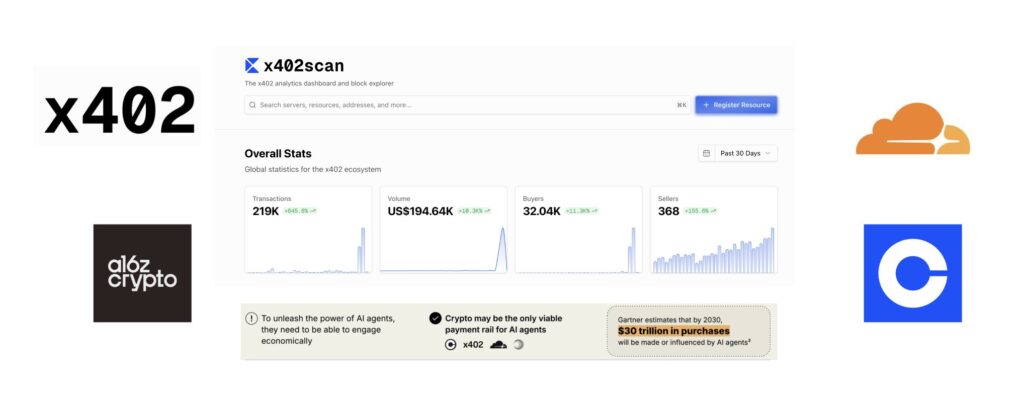
x402 is not just a technical novelty, it’s part of a broader shift where AI agents will increasingly act as spenders, recipients and economic participants. Buying data, paying for compute, or even trading on behalf of other agents or humans may become autonomous. According to a16z, by 2030 that economy could reach $30 trillion in transaction volume.
2. New Revenue Streams for Protocol Builders
If agents pay fees or commissions, or if they pay to access premium APIs (e.g. LLM-powered services), then protocols like x402 can capture value via fees, transaction-based charges, or governance tokens. It may be the next wave of crypto-native infrastructure value accrual.
3. Privacy, Compliance & Risk
When agents transact autonomously, questions arise: who is ultimately liable? How does regulatory KYC/AML apply if non-humans are spending stablecoins? Projects like GoKiteAI paired with Brevis Network suggest privacy-centric implementations are under development. zk-KYC is one potential mitigation.
4. Token Speculation vs Protocol Utility
Several tokens have been built around x402-using ecosystems (e.g. $PING, $VIRTUAL, $DREAM). But it’s unclear how much of their value depends on speculation versus genuine usage. It’s quite possible that much of the long-term value accrues to the infrastructure layer (e.g. Coinbase / Circle), rather than individual tokens with marginal utilities. Investors should distinguish between protocol-layer revenue and tokenised access.
5. Competition & Standards
While x402 is early and gaining momentum, it may not be the only protocol to enable AI-agent payments. Competing standards (centralised or decentralised) could emerge. How x402 interoperates with other MCPs or payments-as-a-service models (Stripe-type rails for AI agents) will shape the market.
Final Thoughts
x402 sits at the intersection of AI agents, stablecoin payments and cryptographic rails. It’s not just a toy project, it’s a foundational protocol aiming to turn agents into economic actors.
If you believe that artificial intelligence will increasingly handle things on your behalf (autonomously ordering compute, paying for data, subscribing to APIs), then infrastructure like x402 becomes critically important.
Whether you are a developer, investor or crypto-curious technologist, you should keep an eye on how x402 evolves: the protocol’s adoption, token utility, partnerships with Circle / Coinbase / cloud & API providers and regulatory positioning.
Leave a Reply