ZKsync’s native token, ZK, witnessed an explosive rally of more than 50% on Saturday, climbing from approximately $0.03 to $0.045, after Ethereum co-founder Vitalik Buterin publicly backed the project. Buterin praised the Layer-2 (L2) scaling solution for its “a lot of underrated and valuable work” within the Ethereum ecosystem.
His endorsement followed a detailed post by ZKsync describing Ethereum as “incorruptible” and outlining how its new Atlas upgrade strengthens the network’s institutional capabilities and liquidity integration. The tweet quickly gained traction among developers and investors, triggering renewed enthusiasm for ZKsync’s vision of a fully integrated, high-speed Ethereum ecosystem.
ZKsync’s Atlas Upgrade: A Leap in L2 Performance
At the heart of this rally lies ZKsync’s Atlas upgrade, the latest milestone in the evolution of the ZK Stack, the modular framework that powers ZKsync’s ecosystem of zero-knowledge (ZK) rollups. Developed by Matter Labs, the Atlas upgrade introduces a high-performance sequencer capable of handling up to 30,000 transactions per second (TPS) while maintaining full Ethereum compatibility.
The upgrade also integrates Airbender, a next-generation confirmation system designed to enable 1-second ZK finality and rapid cross-chain settlements. These improvements dramatically reduce latency between Layer-1 (Ethereum mainnet) and Layer-2 (ZKsync), creating an infrastructure robust enough for enterprise and institutional-grade applications.
With Atlas, ZKsync aims to position itself as a core component of Ethereum’s financial layer, bridging real-world assets (RWA), payments and cross-border settlements with the security and decentralisation of Ethereum’s base layer.
Ethereum as the Real-Time Liquidity Hub
One of the most transformative aspects of Atlas is how it redefines liquidity flow between Ethereum and Layer-2 networks. Previously, each L2 solution, such as Arbitrum, Base, or Optimism, had to establish independent liquidity hubs, fragmenting the ecosystem and forcing users to rely on duplicated liquidity pools.
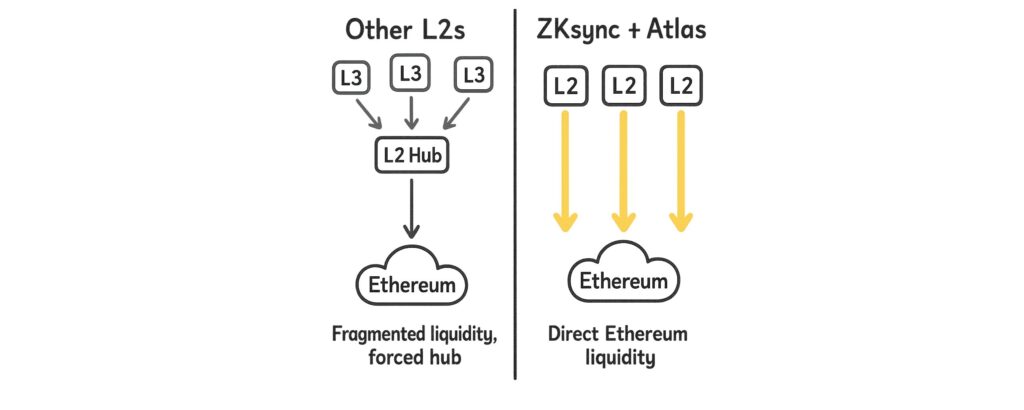
Atlas eliminates this fragmentation by making Ethereum itself the real-time liquidity hub for all ZKsync chains. With L2-to-L2 interoperability at near one second and L1-to-L2 finality faster than an Ethereum block, Atlas allows capital to move across chains with unprecedented speed and security.
This architecture ensures that institutional capital, which typically requires Ethereum-level finality, can flow freely without waiting for long settlement times or bridging delays. The result is a seamless liquidity environment where Ethereum becomes the central financial hub and ZKsync chains act as high-performance extensions rather than isolated ecosystems.
Atlas Unlocks Institutional-Grade Interoperability
Beyond technical speed, Atlas represents a paradigm shift for interoperability and compliance in decentralised finance (DeFi). By combining private control with Ethereum’s public security model, Atlas creates a scalable environment suitable for regulated financial applications.
Institutions can now build bespoke systems that leverage Ethereum’s security guarantees while maintaining operational flexibility through ZK-based privacy and scalability. This makes ZKsync a compelling choice for tokenised asset platforms, cross-border payment providers and enterprise blockchain deployments that demand both performance and trust.
ZKsync’s approach aligns closely with Ethereum’s broader vision of modular scalability, enabling a network of interconnected chains that share liquidity and security without compromising decentralisation.
Buterin’s Praise Reinforces Market Confidence
Vitalik Buterin’s endorsement carried significant symbolic weight. Known for his cautious and principle-driven approach to blockchain innovation, Buterin’s recognition of ZKsync’s contributions signalled renewed confidence in the project’s direction.
By calling ZKsync’s work “underrated and valuable,” Buterin validated Matter Labs’ long-term focus on zero-knowledge proofs (ZKPs), a technology widely considered the future of Ethereum scaling. His remarks also reflect growing consensus that ZK-based Layer-2s will dominate Ethereum’s next growth phase, particularly as demand for secure, low-latency infrastructure continues to rise.
Following Buterin’s comments, trading volumes for ZK tokens surged across major exchanges, with investors anticipating broader adoption of Atlas-powered applications and stronger developer engagement.
ZKsync’s Growing Role in Ethereum’s Future
With Atlas, ZKsync has effectively bridged the final gap between Layer-1 trust and Layer-2 performance, solidifying its position as a key player in Ethereum’s scaling roadmap. By enabling real-time access to Ethereum’s liquidity, it not only enhances capital efficiency but also lays the foundation for interoperable, institutional-grade DeFi.
As the ZK ecosystem matures, ZKsync’s focus on building an “incorruptible” financial settlement layer could reshape how enterprises and developers engage with Ethereum, transforming it from a base layer into a fully connected financial web.
For investors and developers alike, Vitalik Buterin’s endorsement and the subsequent ZK price rally serve as clear signs that ZKsync’s vision is gaining serious traction within the Ethereum community.
Leave a Reply